Who needs to consider UV germicidal sections in ventilation systems today?
Engineers designing ventilation systems must accurately calculate and integrate germicidal UV sections. Food production technologists require assurance of air sanitation in packaging zones. Maintenance personnel need to manage UV equipment amid dust and humidity challenges. Occupational safety and environmental managers oversee compliance with air disinfection standards. Production managers with strict hygiene demands aim to minimize secondary contamination risks. Additionally, organizations servicing sterile areas in healthcare settings require effective ventilation disinfection solutions.
What are the key technical parameters affecting UV disinfection effectiveness?
UV germicidal sections disinfect air by exposing microorganisms to ultraviolet radiation that disrupts their DNA and RNA. The disinfection dose depends on lamp power, exposure time (which inversely relates to airflow speed), and the section’s design. Excessive airflow reduces exposure time and dose, compromising disinfection. Conversely, increasing lamp power without managing heat can cause equipment overheating and reduce lamp lifespan. Verifying on-site performance involves measuring airflow velocity and UV irradiance, ensuring the section is airtight and free of shadow zones where air bypasses UV exposure.
How should germicidal sections be constructed and installed for optimal operation?
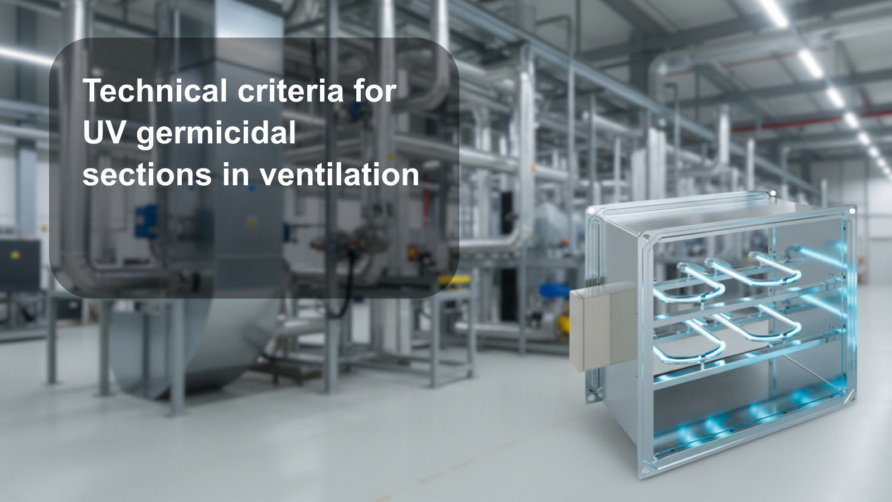
Sections must integrate into existing ventilation without reducing airflow capacity or requiring major modifications. Designs typically connect to round ducts and include diffusers for even air distribution. Access panels on both sides facilitate lamp replacement without dismantling entire units. Materials and seals should withstand high humidity and dust typical in industrial environments. Installation quality is verified by checking joint tightness, vibration absence, noise levels, and lamp mounting integrity. Poor installation can cause air leaks, uneven flow, and “dead zones” with insufficient UV exposure, lowering disinfection effectiveness.
Can you illustrate common pitfalls with a real-world example?
A sauce packaging plant installed UV germicidal sections based on nominal lamp power and duct dimensions without adjusting for actual airflow rates. This led to insufficient UV exposure time, uneven air distribution due to missing diffusers, and difficult lamp access that hindered maintenance. Consequences included repeated air contamination, odor complaints, increased microbial counts, premature lamp failure, and disruptions in packaging operations. Corrective actions involved recalculating parameters, adding diffusers, upgrading lamps, improving access, sealing the unit better, and implementing UV dose and airflow monitoring.
What are frequent mistakes in selecting and operating germicidal UV sections?
Common errors include underestimating actual airflow velocity, resulting in inadequate UV dose; poor installation causing shadow zones and air leaks; inappropriate lamp and power supply choices leading to overheating and failure; lack of maintenance access shortening equipment life; unsuitable materials causing corrosion under humid conditions; and omission of regular UV dose and ventilation parameter monitoring, which prevents timely detection of performance degradation.
What checklist should be followed before implementing a germicidal UV section?
- Confirm actual site conditions match design parameters.
- Ensure uniform air distribution inside the section.
- Verify lamp and power supply technical specifications.
- Guarantee accessible design for lamp servicing.
- Assess airtightness and resistance to dust and moisture.
- Implement UV dose and airflow speed monitoring systems.
- Check compatibility with existing ventilation infrastructure.
- Develop maintenance and lamp replacement schedules.
- Evaluate thermal loads and provide adequate cooling.
- Train personnel on operation and monitoring procedures.
- Conduct commissioning tests and UV dose measurements.
- Maintain spare lamps and parts inventory.
What practical questions arise before purchase and installation?
How to determine required UV lamp power?
It depends on air volume and target UV dose, which varies by microorganism type and airflow speed. Normative guidelines and on-site measurements inform calculations.
Can a germicidal section be installed in existing ducts without changes?
Possible but often requires diffuser installation and design adjustments to ensure even airflow distribution and effective disinfection.
How frequently should UV lamps be replaced?
Amalgam lamps typically last about 16,000 operational hours. Replacement is based on irradiance decline or maintenance schedules.
What parameters require monitoring during operation?
Air velocity, UV irradiance levels, lamp condition, and unit airtightness to detect performance drops or failures.
What if air quality worsens after installation?
Check installation correctness, airflow speed, and distribution uniformity. Shadow zones or insufficient UV dose are common causes.
How to protect UV equipment from dust and moisture?
Use stainless steel enclosures, specialized seals, and pre-filtration of incoming air to extend equipment life and maintain efficiency.
Can germicidal sections be used for air recirculation?
Yes, but higher microbial loads require ensuring UV dose adequacy for effective disinfection.
How to verify effectiveness after installation?
Measure UV dose, airflow velocity, and perform microbiological air sampling upstream and downstream of the section.
What installation features matter in high-humidity industrial settings?
Employ moisture-resistant materials and seals, provide ventilation for the section, and establish regular maintenance to avoid corrosion and failures.
Summary
Selecting and implementing UV germicidal sections in ventilation demands precise calculations and consideration of operational conditions. The principal criterion is matching UV dose to actual airflow velocity with uniform exposure throughout the airflow. On-site measurements, maintenance access, and continuous performance monitoring are essential for sustained disinfection efficiency. The process involves data collection, pilot testing, and development of operational protocols to maintain air sanitation consistently.