Who needs this information and when
- Ventilation system engineers selecting equipment based on process requirements.
- Food industry technologists ensuring microbial safety without altering ventilation setups.
- UV equipment maintenance specialists aiming to extend lamp service life.
- Sanitary control engineers evaluating disinfection effectiveness.
- Manufacturers of bactericidal sections optimizing component selection for performance and durability.
- Technical development managers analyzing costs and energy efficiency.
- Designers of air disinfection systems in healthcare and food production seeking reliable solutions.
Operational principles of amalgam and mercury UV lamps and their impact on disinfection performance
Both amalgam and mercury lamps are low-pressure UV lamps but differ significantly in construction. Amalgam lamps contain a mercury alloy that stabilizes internal mercury vapor pressure across varying temperatures. This stability ensures consistent and high-intensity UV-C emission at 254 nm, critical for effective air disinfection.
Mercury lamps’ vapor pressure is highly temperature-dependent; fluctuations in ambient temperature or high air velocity can reduce UV intensity substantially. This variation directly affects the UV dose delivered, compromising disinfection efficiency.
In practice, amalgam lamps maintain stable bactericidal output over a wider temperature range and longer periods, which is essential in ventilation ducts with variable conditions. Mercury lamps require stricter temperature control; otherwise, disinfection performance may degrade unnoticed without specialized measurements.
Field verification steps include: measuring temperature at lamp location, radiometrically assessing UV intensity at the section outlet, checking power supply stability and electronic ballast operation, measuring air velocity to avoid excessive lamp cooling, and performing microbiological air sampling before and after the UV section.
Neglecting these checks risks reduced disinfection efficacy, potentially allowing pathogen ingress into production areas and deteriorating sanitary conditions.
Design and operational best practices favor amalgam lamps where temperature and airflow fluctuate. For mercury lamps, strict temperature control systems and regular UV intensity monitoring are critical.
Energy consumption and service life: selection criteria
Amalgam UV lamps offer higher efficiency and service lives up to 16,000 hours, significantly exceeding typical mercury lamp lifespans of 8,000–10,000 hours. The mercury alloy stabilizes vapor pressure, preventing emission degradation and physical wear of the lamp envelope.
Amalgam lamps generally consume less energy for equivalent bactericidal output, operating near optimal thermal conditions without overheating. Mercury lamps may require additional cooling or power reduction to avoid overheating, reducing overall efficiency.
On-site evaluation includes measuring power consumption of the ballast unit against specification, visually inspecting lamp envelopes and electrodes after use, and identifying uneven radiation decrease under constant power as a sign of wear or improper conditions.
Choosing mercury lamps without considering operational environment can lead to higher replacement and downtime costs, negating initial savings. Amalgam lamps provide more reliable long-term performance and reduce downtime risks.
Recommendations include factoring in operational parameters beyond purchase price and implementing lamp condition and energy consumption monitoring systems for timely maintenance.
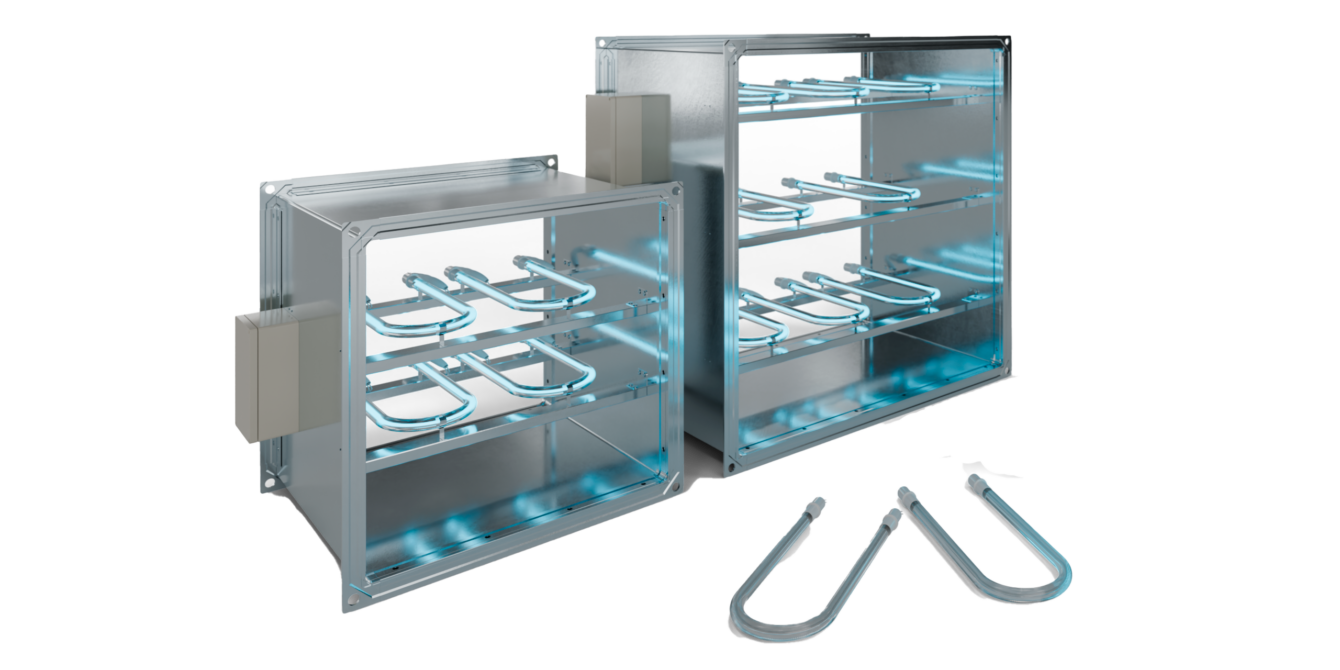
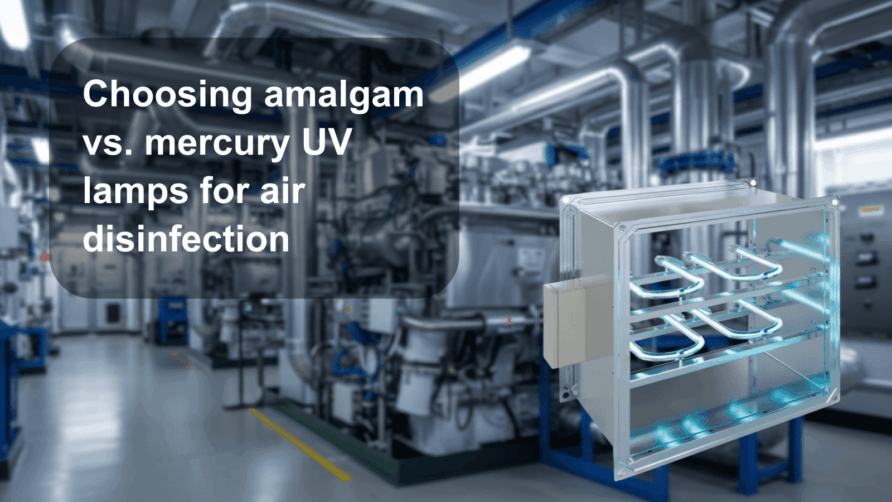
UVL-Vent bactericidal sections based on amalgam UV lamps for installation in ventilation and air conditioning channels in residential and industrial premises. They are used to equip existing or projected air ducts for neutralizing microorganisms: viruses, bacteria, mold spores, and fungi.
Case study: incorrect use of mercury lamps in a food processing plant’s bactericidal section
Initial conditions:
A sauce packaging facility installed bactericidal sections with mercury UV lamps in existing ventilation ducts with variable air temperature and high flow rates.
Observed issues:
- Inconsistent reduction of microbial load in the packaging area air.
- Frequent lamp failures with half the expected service life.
- Increased electricity consumption trying to compensate for reduced lamp output.
- Condensation forming on lamp envelopes.
- Electronic ballast overheating and triggering protective shutdowns.
Root causes:
Mercury lamps were sensitive to temperature and airflow fluctuations. Variable air velocity cooled lamp envelopes excessively, lowering mercury vapor pressure and UV output. Condensation resulted from insufficient thermal insulation and temperature swings. Frequent start-ups and overheating shortened lamp and ballast life. Consequently, the required UV dose was not achieved, compromising air disinfection.
Verification checklist:
- Temperature stability at lamp location.
- Air velocity impact on lamp cooling.
- Lamp envelope condition and condensation presence.
- Ballast operation and power quality.
- UV output measurements with radiometers.
- Microbiological air monitoring before and after the section.
- Installation quality and section sealing.
- Maintenance and lamp replacement history.
Corrective actions:
- Replace mercury lamps with amalgam lamps offering stable vapor pressure.
- Enhance thermal insulation and condensation protection.
- Regulate and stabilize airflow velocity.
- Update ballasts compatible with amalgam lamps.
- Implement regular UV intensity monitoring protocols.
- Train personnel in proper maintenance and monitoring.
Implementation steps:
- Remove old lamps and install amalgam lamps.
- Modify ventilation ducts to optimize airflow.
- Install temperature and humidity control systems.
- Establish maintenance and inspection schedules.
- Conduct follow-up microbiological testing.
- Maintain detailed documentation and control logs.
Outcome:
Post-implementation, UV dose stability improved, lamp replacement frequency decreased, and energy consumption dropped. Microbial air testing confirmed effective disinfection, preserving product quality and reducing sanitary risks.
Common mistakes in selecting and operating UV lamps for bactericidal sections
A frequent error is selecting lamps without considering temperature and airflow conditions, leading to reduced disinfection efficiency. Neglecting regular UV intensity measurements impedes early detection of performance loss.
Improper installation and lack of condensation protection shorten lamp lifespan and cause failures. Using incompatible electronic ballasts results in unstable operation and premature equipment breakdown.
Omission of maintenance and control protocols often causes operation outside design parameters. Additionally, insufficient understanding of amalgam lamp requirements during design can cause overspending or inadequate output.
Pre-installation checklist for bactericidal UV sections
- Confirm lamp type suitability for expected temperature and airflow conditions.
- Plan temperature and humidity monitoring at lamp locations.
- Verify ballast compatibility with selected lamp type.
- Ensure capability for periodic radiometric UV intensity measurements.
- Include measures against condensation and corrosion.
- Ensure correct installation and airtight sealing of sections.
- Organize microbiological air sampling before and after installation.
- Develop maintenance and lamp replacement schedules.
- Train personnel on operation and monitoring procedures.
- Analyze energy consumption and lamp lifespan projections.
- Maintain spare lamps and components for rapid repair.
- Ensure compliance with applicable sanitary standards.
Frequently asked questions before purchase and deployment
Which lamp type is better for unstable temperature conditions?
Amalgam lamps maintain stable UV output under temperature fluctuations and variable airflow due to stabilized mercury vapor pressure.
Can mercury lamps be used at high air velocities?
Mercury lamps are sensitive to cooling effects at high airflow; additional temperature control or reduced airflow is necessary to maintain efficiency.
How often should UV intensity be measured?
Quarterly radiometric checks or whenever operational conditions change are recommended.
What affects amalgam lamp lifespan?
Stable power supply, ambient temperature, and proper installation without condensation are key factors.
Can mercury lamps be replaced with amalgam lamps without equipment changes?
Not always; amalgam lamps may require compatible ballasts and differ in size, necessitating compatibility verification.
How to assess disinfection effectiveness on-site?
Microbiological air testing before and after the UV section, combined with UV dose measurements using radiometers.
What to do if condensation appears on lamps?
Improve thermal insulation and ventilation, and verify temperature and humidity conditions.
How to reduce energy consumption of bactericidal sections?
Select amalgam lamps with appropriate power, use high-efficiency ballasts, and maintain stable operating conditions.
Conclusion
Selecting between amalgam and mercury UV lamps for bactericidal sections is a critical engineering decision that impacts disinfection quality and operational costs. Amalgam lamps provide stable UV output and longer service life under variable temperature and airflow, while mercury lamps demand stringent environmental control. The primary criterion is alignment of lamp characteristics with actual ventilation conditions and implementation of monitoring systems. The next steps involve data collection on-site, pilot testing, and establishing maintenance protocols to ensure reliable and effective bactericidal operation.