Who needs this information and when
- Water treatment system designers — to select UV systems based on source water quality.
- Operations engineers — for monitoring water parameters and timely UV sterilizer maintenance.
- Food and pharmaceutical technologists — to maintain sanitary standards during water disinfection.
- Wastewater treatment specialists — to ensure effective disinfection amid variable turbidity and organics.
- Plant managers with flow-through installations — to assess risks of UV sterilizer performance loss.
- Engineering system integrators — when adapting UV equipment to specific water characteristics.
- Laboratory analysts — for routine monitoring of turbidity, color, and organic content before UV treatment.
How turbidity affects UV sterilizer performance in water treatment
Turbidity represents suspended particles that scatter and absorb UV radiation, physically shading microorganisms and reducing UV dose delivered. Higher turbidity shortens the effective UV penetration depth, directly lowering disinfection efficiency.
In practice, turbidity is measured with a turbidimeter. For flow-through UV sterilizers, recommended turbidity levels typically range from 1 to 5 NTU, depending on lamp power and system design. On-site turbidity checks are straightforward: sampling water before the UV unit and measuring turbidity. Frequent turbidity fluctuations indicate the need for additional pretreatment such as filtration or coagulation.
Ignoring turbidity control leads to incomplete disinfection, increasing microbial contamination risks and compromising hygiene standards. Moreover, elevated turbidity accelerates fouling of quartz lamp sleeves, raising maintenance frequency and costs.
To ensure stable UV sterilization, regular turbidity monitoring and a pretreatment system are essential. Even short-term turbidity spikes require prompt operational adjustments.
Impact of water color on UV disinfection effectiveness
Color in water is caused by dissolved substances like humic acids, iron, manganese, and organic compounds that impart yellow to brown hues. These substances absorb UV radiation, reducing intensity and thus disinfection efficiency.
Unlike turbidity, color is harder to measure quickly on-site without specialized equipment. It is typically assessed in a laboratory following standardized methods. Visual inspection combined with periodic lab analysis can provide practical monitoring. Color values above 15–20 mg/L (Pt-Co units) notably reduce UV sterilizer performance.
Neglecting color effects results in underutilized UV lamps and persistent microbial loads, forcing increases in lamp power or reactor length — adding complexity and cost.
Mitigation involves pretreatment techniques such as activated carbon adsorption, ion exchange, or coagulation. Since organics and color are interrelated, an integrated water preparation approach supports consistent UV disinfection.
Influence of organic matter on flow-through UV sterilizers
Dissolved organic matter absorbs UV light and creates shadow zones where microorganisms can survive. Organics also promote biofilm formation on internal surfaces, including quartz lamp sleeves.
Organic content is typically monitored via chemical oxygen demand (COD) or biochemical oxygen demand (BOD) indicators. Elevated levels above 5–10 mg/L signal potential UV performance degradation. Seasonal water quality changes make regular monitoring critical.
Failure to manage organics leads to increased cleaning frequency, more frequent lamp replacements, and higher power requirements. Organics can serve as nutrient sources for bacteria, reducing disinfection effectiveness and potentially fostering resistant microbial communities.
Implementing comprehensive monitoring and treatment—mechanical filtration, sorbents, and routine cleaning—helps maintain UV sterilization efficiency.
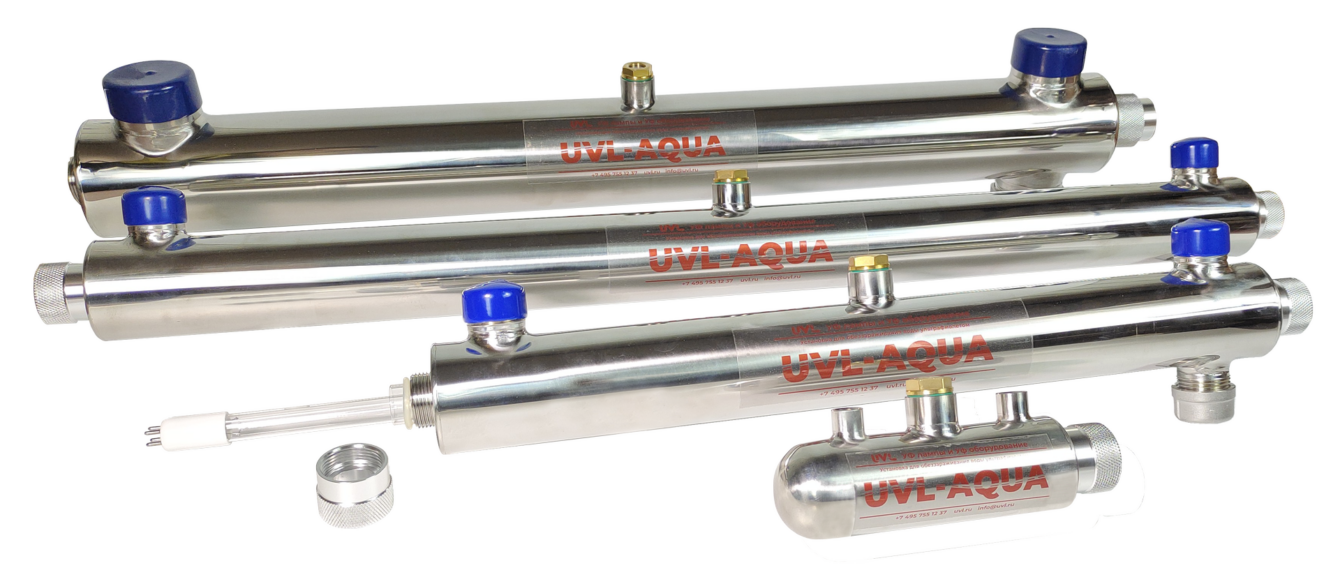
Stainless steel housing units provide water disinfection up to 99% SA in the water treatment system. They are connected to the pipeline using pipes of various cross-sections. Upon request, it is possible to produce a unit with the required parameters.
Case study: reduced UV sterilizer efficiency due to high turbidity
Initial conditions: A flow-through UV system was installed at an industrial facility using surface water with variable turbidity, especially after rainfall.
Symptoms:
- Increased microbial counts post-UV treatment.
- Rapid fouling of quartz lamp sleeves.
- Unexpected drop in water transparency within the system.
- Frequent downtime for cleaning and maintenance.
Cause: Elevated turbidity created shadowing zones preventing sufficient UV dose delivery. Suspended particles deposited on quartz sleeves, impairing UV transmission and accelerating lamp degradation. Lack of pretreatment and infrequent turbidity monitoring delayed problem detection.
Checks to perform:
- Turbidity level before UV unit.
- Condition and cleaning intervals of quartz sleeves.
- Presence and efficiency of pretreatment filtration.
- UV lamp power stability.
- Microbiological test results after UV treatment.
- Maintenance schedules and cleaning protocols.
- Visual inspection of incoming water.
- Hydraulic retention time in UV reactor.
Solutions:
- Install fine filtration pretreatment.
- Implement continuous turbidity monitoring.
- Increase frequency of quartz sleeve cleaning.
- Optimize lamp operation and increase power if necessary.
- Establish microbiological monitoring protocols.
- Train personnel on equipment and water quality parameters.
Implementation:
- Installed filtration system upstream of UV unit.
- Automated turbidity control configured.
- Maintenance procedures documented and enforced.
- Engineering staff trained.
- Logging system for UV sterilizer operation introduced.
- Periodic review and adjustment of process parameters.
Outcome: Post-implementation, disinfection efficiency met standards. Lamp fouling decreased, reducing downtime and maintenance costs. Microbiological control confirmed consistent microbial reduction.
Common mistakes when operating UV water sterilizers
- Skipping pretreatment to remove suspended and dissolved solids, undermining UV effectiveness.
- Insufficient monitoring of turbidity and color leading to unexpected disinfection failures.
- Incorrect UV system sizing without accounting for actual water parameters, causing over- or underperformance.
- Neglecting quartz sleeve cleaning and replacement, which reduces UV transmission.
- Lack of maintenance protocols and operational control leading to equipment degradation.
- Overlooking organic matter impact, increasing biofilm formation and reducing disinfection.
Pre-installation checklist for UV water sterilizers
- Assess turbidity and color parameters of source water.
- Design and include suitable pretreatment systems.
- Determine appropriate UV system power and configuration.
- Verify capability for regular water quality monitoring.
- Ensure access for quartz sleeve cleaning and lamp replacement.
- Train operational personnel in system use and monitoring.
- Establish maintenance and quality control procedures.
- Confirm compatibility with existing infrastructure.
- Implement automatic alerts for performance drop.
- Evaluate organic content and plan treatment accordingly.
- Arrange laboratory analyses for microbiological verification.
- Conduct pilot testing under actual site conditions.
Frequently asked questions before UV sterilizer purchase and commissioning
How does turbidity influence UV sterilizer selection?
Higher turbidity reduces UV penetration, necessitating pretreatment or higher power and longer reactors.
Can UV systems be operated without pretreatment?
Generally no; suspended solids and organics impair UV effectiveness, risking incomplete disinfection and higher maintenance.
How often should turbidity and color be checked?
At least once per shift or upon changes in water quality and after incidents.
What to do if UV sterilizer efficiency drops?
Check turbidity, color, quartz sleeve condition, and lamp power; adjust filtration and operational parameters accordingly.
How does organic matter affect UV operation?
It absorbs UV light and fosters biofilms, decreasing disinfection and increasing maintenance.
What water parameters are critical for flow-through UV sterilizers?
Turbidity, color, organic content, temperature, and flow rate—all affect UV dose and disinfection outcome.
Is it possible to assess UV effectiveness without lab tests?
Partially, using UV sensors and turbidimeters; however, microbiological assays are needed for accurate verification.
Summary
The effectiveness of UV water sterilizers depends not only on equipment specifications but also on source water characteristics—turbidity, color, and organic content. Ensuring water clarity for UV transmission and implementing regular water quality monitoring at the system inlet are key success factors. Integrating pretreatment, monitoring, and maintenance protocols supports stable disinfection performance.
Next steps include collecting site-specific water data, conducting pilot tests of selected equipment, and developing operational guidelines. This systematic approach helps avoid common pitfalls and ensures reliable UV disinfection of potable water.