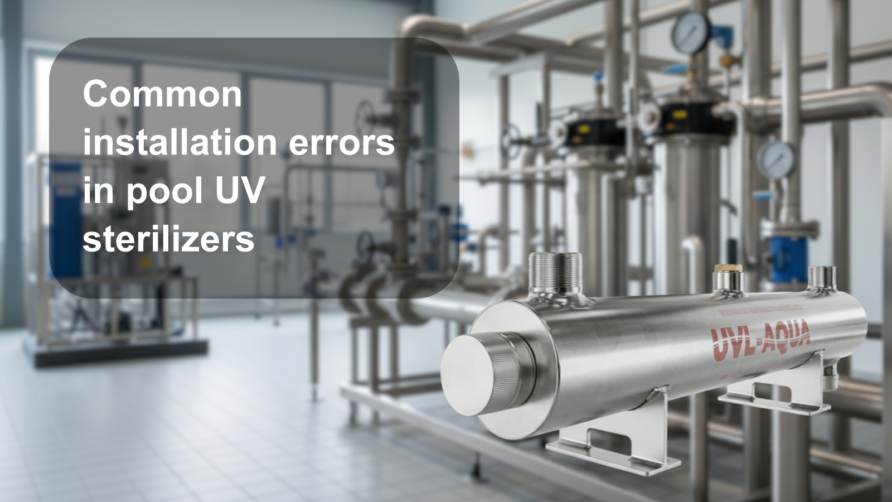
Ultraviolet (UV) sterilizers are increasingly used by engineers and technologists responsible for water quality and operational safety in pool facilities. However, improper installation and integration often reduce disinfection efficiency and increase operational costs. It is essential for specialists to understand key technological aspects of UV sterilizer installation to avoid common mistakes and ensure reliable equipment performance. This article reviews real-world cases where mismatched lamp dimensions and incorrect setup caused system failures, and provides practical recommendations for selecting, verifying, and maintaining UV sterilizers for pools.
By following these guidelines, engineers will be able not only to select an appropriate UV unit for pool water disinfection but also to correctly integrate it into the circulation system, minimizing risks and downtime.
Who needs this and when
- Pool design engineers — to correctly select and integrate UV sterilizers into water treatment systems.
- Operations technologists — to monitor equipment parameters and promptly detect deviations.
- Service engineers — to perform error-free installation and commissioning.
- Pool managers with high usage — to maintain stable microbiological water quality.
- Water treatment specialists — when upgrading or replacing chemical disinfection methods with UV.
- Equipment manufacturers — to develop and adapt UV sterilizers to specific technical conditions.
Installation features: why precision matters
A UV sterilizer disinfects pool water by exposing it to bactericidal radiation at a specified energy dose as water flows through the reactor. Precise positioning of the UV lamp within the reactor, considering lamp length, diameter, and reactor design, is critical. Mismatched lamp dimensions often cause sealing issues, unreliable mounting, and startup failures.
On site, verifying lamp length, base type, and envelope size against technical documentation is a fundamental step. Pressure and tightness of all connections must be checked to prevent leaks and cavitation.
Ignoring these parameters may lead to lamp startup failure, premature lamp burnout, or reduced UV output. Consequently, water disinfection becomes ineffective, increasing microbial load and the risk of non-compliance with sanitary standards.
It is recommended to carefully control lamp dimensions during procurement and installation and to use only verified models with full technical documentation. Templates or calibration tools can accelerate on-site verification.
Proper connection and integration into the circulation system
The UV sterilizer must be installed so that water flows through the reactor at the required velocity with even distribution. This means pipeline diameter, pressure, and flow rate must match the equipment’s design specifications.
In practice, flow rate and pressure are measured at the UV unit’s inlet and outlet. It is crucial to ensure flow velocity does not exceed the maximum allowed, as excessive speed reduces exposure time and disinfection effectiveness. Correct fittings and seals made of UV-resistant and corrosion-resistant materials must be used during installation.
Excessive flow velocity results in insufficient UV dose delivery, while overpressure can damage the reactor housing and cause leaks. Improper connection complicates maintenance and repair, increasing downtime.
Installing flow and pressure sensors, along with automatic protection against dry running, is recommended to promptly detect and address system malfunctions.
UV dose setting and monitoring
The UV sterilizer disinfects water by delivering a specified UV dose, measured in mJ/cm². Accurate setting and continuous monitoring of this dose are critical to comply with sanitary requirements and ensure safety.
Dose measurement is performed on site using dedicated UV sensors installed inside the reactor. Regular monitoring helps detect lamp power decline due to quartz sleeve fouling or lamp aging. Automation should be configured to shut off the system if the dose falls below the required threshold.
Failure to control UV dose may result in insufficient disinfection, microbial growth, and sanitary violations. Excessively high doses are inefficient and increase energy consumption.
It is advisable to conduct scheduled UV dose checks at least monthly and include routine cleaning and lamp replacement in maintenance protocols.
Case study: lamp dimension mismatch and startup failures in a dolphinarium pool system
Background: A dolphinarium used a pool circulation system with a medium-pressure UV sterilizer. Replacement lamps were ordered as equivalents but caused installation and startup problems.
Symptoms:
- Lamps did not fit reactor housing due to length mismatch.
- System failed to start, triggering sensor errors.
- One lamp failed after less than 1000 hours.
- Leakage occurred at lamp mounting points.
- Disinfection effectiveness decreased.
Root cause: A 5 mm lamp length difference disrupted mechanical fit and sealing. The lamp base with rotating pins did not match the original, causing unstable electrical contact and startup faults. Deviations from original technical parameters reduced lamp lifespan and UV output.
Points to verify:
- Exact lamp dimensions (length, diameter, base).
- Compatibility with reactor and mounting fixtures.
- Sealing tightness of all connections.
- Proper electrical and control wiring.
- Functionality of flow and UV dose sensors.
- System pressure and flow velocity.
- Condition of the quartz sleeve.
- Error logs in the control system.
Resolution steps:
- Manufacture prototype lamps matching original specifications precisely.
- Perform trial installation and system adjustment on site.
- Adjust lamp length and base design as needed.
- Ensure sealing and tightness control.
- Update maintenance procedures to reflect new parameters.
- Train staff on operational specifics of the updated equipment.
Implementation:
- Commission corrected lamps.
- Conduct startup and operational testing.
- Monitor UV dose and pipeline pressure continuously.
- Establish regular monitoring and maintenance schedules.
- Document results in technical records.
- Secure access to spare parts with exact specifications.
Outcome is verified by continuous monitoring of microbiological water quality and UV sterilizer parameters. After corrections, the system operates stably, delivering the required disinfection dose and reducing sanitary risks.
Common errors when integrating UV sterilizers into pools
Typical issues include:
- Ignoring water flow velocity, reducing disinfection effectiveness.
- Using lamps with incompatible technical parameters causing failures and burnout.
- Neglecting quartz sleeve cleaning, decreasing UV transmission.
- Absence of flow and UV dose sensors, complicating monitoring.
- Poor sealing leading to leaks and corrosion.
- Lack of automatic protection against flow interruption causing lamp damage.
- Incorrect power supply connection causing control system faults.
These oversights reduce equipment lifespan and degrade water disinfection quality.
Pre-installation checklist for pool UV sterilizers
- Verify lamp technical parameters and reactor compatibility.
- Ensure correct pipeline diameter and material selection.
- Confirm sealing tightness of all joints and fittings.
- Measure and align flow velocity with equipment specifications.
- Configure and test flow and UV dose sensors.
- Implement automatic protection against dry running.
- Provide access to spare lamps with exact specifications.
- Develop maintenance schedule for quartz sleeve cleaning and lamp replacement.
- Train maintenance personnel on operation and safety.
- Perform commissioning with parameter documentation.
- Set up system monitoring and logging.
- Check correct power and control wiring connections.
Frequently asked questions before purchase and integration
How to select the appropriate UV lamp power for a pool?
Lamp power depends on water volume, circulation rate, and required disinfection dose. Medium-pressure lamps rated 2–2.5 kW are typically used for large pools to provide necessary UV intensity.
What if original lamps are unavailable?
Lamps must be manufactured or procured with exact compliance to technical specifications: length, diameter, base, and power. Approximate fitting is unacceptable as it leads to failures and shortened lamp life.
How to confirm effective UV sterilizer operation?
Monitor UV dose via built-in sensors, regularly analyze microbiological water quality, and inspect lamp and sleeve condition.
Which materials are preferred for the reactor housing?
Stainless steel AISI-316 is preferred for corrosion resistance and durability. Plastic housings are rarely used and only in low-demand applications.
How often should lamps and quartz sleeves be replaced?
Medium-pressure lamps typically last 9000–12000 operational hours. Quartz sleeves require regular cleaning and replacement depending on fouling, usually once per season.
Can a UV sterilizer be integrated without reconstructing the existing system?
Yes, if pipeline diameter and pressure match. Proper fittings and tight seals are essential.
What to do in case of pressure fluctuations?
Install pressure stabilizers or configure automatic UV lamp shutdown at critical pressure to prevent damage.
Ultraviolet water disinfection in pools is an effective and environmentally sound method for maintaining water quality. The key to successful integration is strict adherence to equipment technical specifications and operating conditions. The next steps include system data collection, pilot testing, and development of maintenance protocols. This approach ensures stable UV sterilizer operation and compliance with sanitary standards.