In industrial settings, air disinfection is a critical factor for ensuring process safety and product quality. Engineers and technologists must select methods that effectively reduce microbial contamination without disrupting production or introducing additional hazards. Among commonly used solutions are ultraviolet (UV) air disinfectors and chemical disinfection methods. Each has distinct characteristics, limitations, and application scopes.
This article explains the operating principles of open UV lamps and UV air recirculators, compares them with chemical disinfection approaches, highlights common errors in selection and operation, and offers practical recommendations for monitoring and implementation. For example, improper UV disinfector selection can result in insufficient microbial reduction, while excessive chemical use may cause equipment corrosion and deteriorate workplace conditions.
Who needs this and when
- Ventilation and air conditioning engineers — to select optimal UV devices for ventilation systems.
- Food and pharmaceutical production technologists — to reduce microbial load in manufacturing areas.
- Industrial facility maintenance teams — to service and verify disinfection effectiveness.
- Air disinfection system designers — to integrate UV equipment into engineering layouts.
- Occupational safety managers — to assess the safety of chemical and UV methods.
- Sanitary control specialists — to evaluate compliance with operational standards.
- Production managers in environments with high air contamination — to choose disinfection methods suited to specific conditions.
How UV disinfectors and chemical methods work: physics and chemistry overview
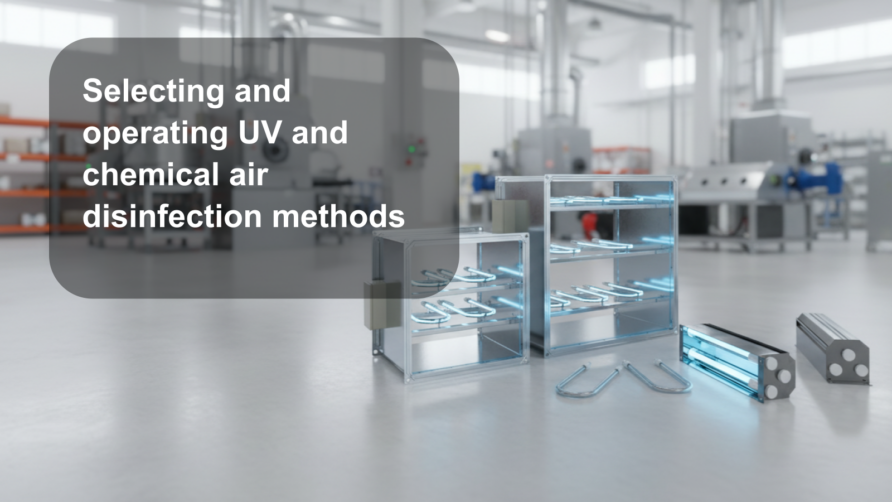
Bactericidal UV air disinfectors operate by emitting shortwave ultraviolet radiation, typically around 254 nm, which damages microbial DNA and RNA, thereby disinfecting air. Open UV lamps directly irradiate air and surfaces but must be used only in unoccupied spaces due to risks to skin and eyes. UV air recirculators are enclosed units that pass air through a UV-irradiated chamber, allowing safe operation in the presence of personnel.
Chemical disinfection involves spraying or treating air and surfaces with antiseptic solutions such as hypochlorite or hydrogen peroxide. These provide rapid disinfection but require subsequent ventilation and can negatively affect equipment and indoor climate.
For engineers, UV recirculator effectiveness depends on air residence time in the irradiation zone and lamp intensity. Insufficient exposure time or lamp power reduces efficacy. Chemical methods require even distribution of disinfectant and controlled contact time.
On site, UV disinfector performance can be verified by measuring UV intensity at the device outlet and monitoring microbial counts before and after treatment. Chemical disinfection quality is checked by measuring residual disinfectant concentration and microbial load.
Failure to comply with required exposure times and UV intensity leads to incomplete disinfection and microbial buildup. Improper chemical use causes corrosion, odors, and worsened indoor conditions.
Selection should consider room volume, contamination level, and operation mode. For occupied spaces, UV recirculators are preferred; for intermittent rapid treatment, open UV lamps are suitable. Chemical methods are best applied as supplementary or where UV use is limited.
Impact of UV disinfector design and type on air disinfection effectiveness
Design details determine how UV air disinfectors affect microbial contamination. Open UV lamps emit radiation directly into the room, enabling quick disinfection of air and surfaces but require no personnel presence during operation. UV air recirculators are enclosed units with fans that pull air through a UV lamp chamber, reducing human exposure risks and enabling use in occupied zones.
Key factors to monitor on site:
- Installation location: open UV lamps must be positioned to avoid irradiating workers.
- Airflow rate in recirculators: excessive speed reduces exposure time and effectiveness.
- Lamp intensity and operational condition.
- Matching power and number of units to room volume.
Incorrect installation, such as operating open UV lamps in occupied areas, poses health hazards and potential safety incidents. High airflow velocity in recirculators lowers bactericidal effect, allowing microbes to survive.
Use placement schemes and calculations based on standards. Select recirculators with capacity margin to ensure adequate exposure time. For open UV lamps, implement interlocks and alarms to prevent operation when personnel are present.
Chemical air disinfection methods: application specifics and limitations
Chemical air disinfection in industrial environments relies on spraying disinfectant solutions that disrupt microbial cell structures. These methods are often used for rapid treatment of large air volumes and hard-to-reach surfaces. However, they require strict control of disinfectant concentration and exposure time, as well as mandatory ventilation after treatment.
Effectiveness can be assessed by measuring residual active substance concentrations and microbial load. Equipment and materials must be monitored as aggressive chemicals may cause corrosion and damage.
Ignoring dosing or exposure requirements decreases disinfection efficiency, while overuse increases equipment repair costs and degrades working conditions.
Chemical methods are recommended as adjuncts, particularly for comprehensive disinfection or when UV use is impractical. Personnel safety measures and process parameter controls are essential.
Case study: mistakes in implementing UV air recirculators in food production
Initial conditions
A food production facility installed multiple UV air recirculators aiming to reduce microbial contamination in the packaging area. The design underestimated required performance and did not account for airflow speed.
Symptoms
- Persistently high microbial contamination in air.
- Increased product defects due to microbiological contamination.
- Worker complaints about noise and vibration.
- Frequent recirculator shutdowns from overheating.
Root causes
Recirculators had insufficient capacity to provide necessary air exposure time, allowing microbes to survive. High airflow reduced UV contact time. Improper placement resulted in uneven coverage. Noise and vibration indicated incorrect fan installation, reducing equipment lifespan.
Checklist for verification
- Technical specifications and certificates of UV devices.
- Airflow rates through recirculators.
- Installation locations and quantity relative to room volume.
- Lamp condition and UV intensity.
- Noise and vibration levels at mounting points.
- Presence of monitoring and alarm systems.
- Maintenance and lamp replacement schedules.
- Microbial measurements before and after installation.
Solution
- Recalculate required capacity considering room volume and contamination.
- Increase number of recirculators for uniform coverage.
- Adjust fan speed for optimal exposure time.
- Implement regular UV intensity monitoring.
- Correct installation to reduce noise and vibration.
- Establish maintenance protocols.
Implementation
- Install additional recirculators with appropriate capacity.
- Fine-tune airflow speed in each unit.
- Train personnel on operation and monitoring.
- Schedule regular maintenance.
- Conduct ongoing microbial monitoring.
- Implement emergency alarm systems.
Outcome
Post-correction microbial air quality improved significantly, product defects decreased, and noise/vibration were reduced to acceptable levels. Regular control and maintenance maintained stable disinfection performance.
Common errors in selecting and operating air disinfection methods
Frequent mistakes include: choosing UV disinfector type without considering operation mode and personnel presence; underestimating required capacity and exposure time; lacking UV intensity and lamp condition controls; neglecting safety requirements for open UV devices; improper chemical dosing and exposure; insufficient microbial monitoring; absence of maintenance schedules and staff training.
These errors reduce disinfection effectiveness, increase health risks, and raise repair and downtime costs.
Pre-implementation checklist
- Verify room volume and purpose.
- Determine presence or absence of personnel during operation.
- Calculate required UV disinfector capacity and power.
- Assess installation feasibility and placement.
- Evaluate airflow rates in recirculators.
- Provide UV intensity monitoring systems.
- Implement safety measures and alarms.
- Select chemical agents considering compatibility and safety.
- Define maintenance and lamp replacement procedures.
- Train staff on operation rules.
- Plan microbial monitoring.
- Prepare emergency response plans.
Frequently asked questions before purchase and implementation
Which UV disinfector type is best for production halls?
For occupied spaces, UV recirculators are preferable due to safety and continuous operation. Open UV lamps suit rapid treatment when personnel are absent.
How to control UV disinfector effectiveness?
Key parameters are lamp UV intensity and microbial air quality before and after treatment. Regular technical inspections and lamp replacements are mandatory.
Can UV disinfection be fully replaced by chemical methods?
Chemical methods work but have safety and equipment impact limitations. Combined use with UV is recommended.
How to avoid corrosion and damage when using chemicals?
Proper dosing, exposure time adherence, and post-treatment ventilation are essential.
What if the room has complex shape or corridor layout?
Increase treatment frequency and number of UV units to ensure uniform coverage.
Which parameters affect recirculator capacity selection?
Room volume, microbial load, airflow rate, and UV intensity.
How to ensure safety using open UV lamps?
Install interlocks, alarms, and inform personnel about operation schedules.
What to do if UV lamp intensity drops?
Replace lamps promptly as their effectiveness declines with wear.
Summary
Choosing between UV air disinfectors and chemical methods depends on operational conditions, safety requirements, and production specifics. The key criterion is matching device power and design to room volume and operation mode. Successful implementation requires precise parameter calculations, ongoing monitoring, and maintenance. Next steps include data collection on site, pilot testing, and developing operational protocols.