Maintaining optimal indoor air quality and reducing microbial contamination in industrial environments is a critical challenge for engineers and process specialists today. Ultraviolet (UV) air disinfection units, including open UV emitters and bactericidal air recirculators, are widely employed to disinfect and sanitize air streams. However, improper selection or incorrect operation of these systems can significantly diminish disinfection effectiveness and may lead to increased operational costs and safety risks.
This article outlines the key criteria for selecting UV air disinfection units for industrial spaces, highlights typical design and operational mistakes, and provides practical guidance on implementation and performance verification. You will learn how to assess equipment requirements based on room conditions, avoid common errors, and verify outcomes on-site.
For example, in food processing facilities, the introduction of air recirculators led to a reduction in mold colonies, but without proper power sizing and placement, the disinfection effect was limited. Conversely, the use of open UV emitters without restricting human access caused safety concerns and regulatory non-compliance.
Who Needs This and When
- HVAC System Designers — to integrate UV units into ventilation schemes while ensuring safety and efficacy.
- Production Technologists — to maintain microbiological air cleanliness and reduce contamination risks.
- Occupational Safety Specialists — to evaluate and monitor safe use of UV equipment.
- Service Engineers — to perform proper maintenance and timely lamp replacement.
- Facility Managers — to plan budgets and assess economic feasibility of UV system deployment.
- Operational Staff — to manage correct operating modes and monitor system parameters.
- Air Disinfection System Designers — to select between open UV emitters and recirculators based on operational conditions.
Criteria for Selecting UV Air Disinfection Units
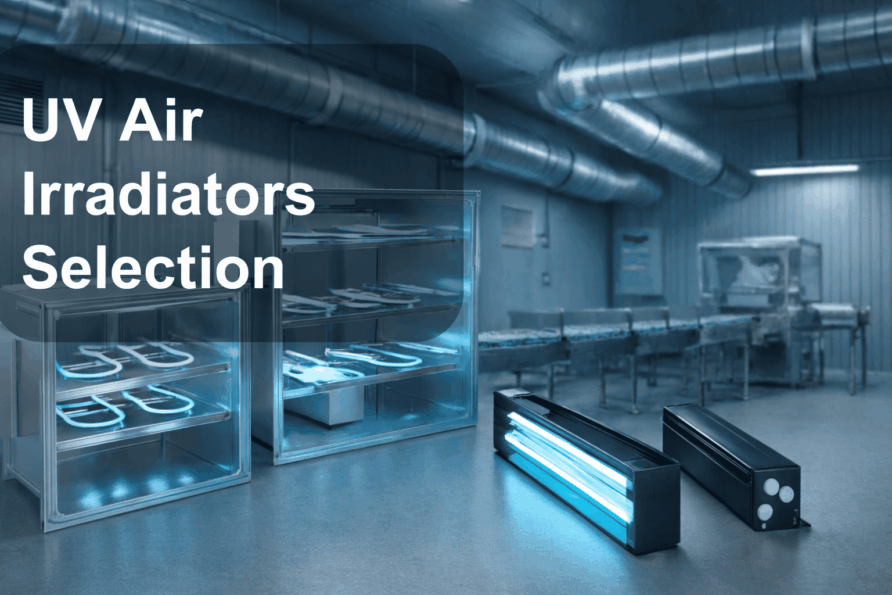
Choosing the appropriate UV air disinfection device begins with analyzing operating conditions and disinfection requirements. Open UV air emitters are effective for short-term treatment of unoccupied spaces, whereas bactericidal air recirculators are designed for continuous operation in occupied areas.
How to Verify
- Determine the room volume and operational mode: continuous or intermittent disinfection.
- Review equipment manuals for permissible operating conditions (temperature, humidity).
- Confirm availability of certificates and technical datasheets detailing efficacy calculations for the specific room volume and type.
- Calculate the required number of units and operating duration based on expected microbial load.
- Assess compatibility and integration options with existing ventilation systems.
- Verify safety features such as protective interlocks, alarms, and access restrictions.
Common mistakes at this stage include underestimating room volume, mismatching lamp power, and neglecting exposure time calculations. For instance, installing a single open UV emitter in a large workshop will not achieve the required microbial reduction.
Recommendations
- Use air recirculators for air disinfection in the presence of personnel, especially for continuous operation.
- Employ open UV emitters for rapid disinfection of vacant rooms, ensuring strict access control.
- Consider room geometry and ventilation characteristics when determining installation locations.
- Request efficacy calculations from manufacturers tailored to your conditions.
- Plan for regular maintenance and UV lamp replacement.
Case Study: Incorrect Selection of Open UV Emitter for a Manufacturing Workshop
Initial Conditions
A manufacturing workshop with a volume of 800 m³ and continuous staff presence. An open UV air emitter was chosen to reduce microbial contamination.
Observed Issues
- No significant reduction in microbial contamination per laboratory testing.
- Staff reported discomfort during operation of the emitter.
- Frequent equipment shutdowns due to safety requirements.
- Non-compliance with operational regulations for open UV units.
Root Cause
Open UV emitters are intended for use in unoccupied spaces and short-term disinfection cycles (up to 30 minutes). Their operation in occupied areas violates safety protocols and reduces effectiveness due to frequent shutdowns. Moreover, the power of a single emitter was insufficient for the room volume, failing to achieve the desired air disinfection level.
What to Verify
- Compatibility of emitter type with operational mode and room conditions.
- Availability of usage instructions and regulatory guidelines for open UV units.
- Equipment power and coverage area.
- Microbial contamination levels before and after treatment.
- Access control and safety measures.
- Operation frequency and duration.
- Emitter placement within the room.
- Feasibility of switching to recirculators or enclosed units.
Recommended Actions
- Transition to bactericidal air recirculators approved for use in occupied spaces.
- Calculate the required number of recirculators based on room volume and microbial load.
- Ensure correct placement considering airflow patterns.
- Establish operation and maintenance protocols.
- Train personnel on safe operation of UV equipment.
Implementation
- Procurement and installation of recirculators with verified efficacy.
- Development and approval of operation manuals.
- Organization of routine microbial load monitoring.
- Configuration of safety alarms and access controls.
- Scheduling of maintenance and lamp replacement.
Outcome Monitoring
Post-implementation, microbial contamination levels dropped to acceptable standards, and staff operated in a safe environment. Regular monitoring confirmed consistent disinfection performance.
Case Study: Incorrect Exposure Time Calculation for Open UV Emitter
Initial Conditions
A cleanroom-type facility with a volume of 144 m³, classified as cleanliness class "A". A portable open UV air emitter was used to prepare the room for operation.
Observed Issues
- Insufficient air disinfection after standard exposure time.
- Repeated treatments with no noticeable improvement.
- Non-compliance with exposure time regulations.
Root Cause
Exposure time was set based on nominal equipment data without accounting for actual room volume and geometry. No effective calculation of disinfection duration was performed, resulting in inadequate UV dose for microbial inactivation.
What to Verify
- Room volume and cleanliness classification.
- Equipment specifications — power and recommended exposure time.
- Emitter placement and uniformity of irradiation.
- Microbial contamination before and after treatment.
- Compliance with exposure time standards.
- Potential to extend exposure time or increase treatment cycles.
Recommended Actions
- Calculate effective exposure time considering room volume and lamp power.
- Increase exposure duration to values derived from calculation.
- If necessary, deploy additional equipment to ensure uniform coverage.
Implementation
- Update disinfection protocols.
- Train staff on correct exposure times and procedures.
- Implement microbial load monitoring post-treatment.
Outcome Monitoring
After adjusting exposure time and treatment procedure, the required level of air disinfection was achieved, confirmed by laboratory analysis.
Common Mistakes in Selecting and Operating UV Air Disinfection Units
- Selecting open UV emitters for occupied spaces without additional safety measures.
- Underestimating room volume and equipment power requirements.
- Omitting calculations for exposure time and treatment frequency.
- Incorrect placement leading to uneven UV exposure.
- Neglecting maintenance and UV lamp replacement schedules.
- Violating safety protocols and access controls.
- Failing to monitor disinfection effectiveness.
- Using equipment lacking verified technical documentation and efficacy data.
Pre-Implementation Checklist for UV Air Disinfection Units
- Assess room volume and geometry.
- Define operational mode: continuous or intermittent.
- Select equipment type: open emitter or air recirculator.
- Calculate quantity and power of units required.
- Verify manufacturer’s certificates and operation manuals.
- Ensure safety features: interlocks, alarms, access restrictions.
- Plan equipment placement considering airflow patterns.
- Organize personnel training.
- Schedule maintenance and lamp replacement.
- Develop protocols for efficacy monitoring.
- Implement microbial load monitoring systems.
- Enforce access control and safety compliance.
Frequently Asked Questions Before Purchasing and Implementing UV Units
Which type of UV air disinfection unit should be selected: open emitter or recirculator?
The choice depends on operating mode and human presence. Open emitters are suitable for short-term treatment of unoccupied spaces; recirculators are designed for continuous use in occupied areas.
How to calculate the required number of units?
Base calculations on room volume, target disinfection level, and lamp power. Manufacturers often provide calculation methods or software tools for selection.
Can open UV emitters be used when personnel are present?
No, open emitters must only operate in unoccupied spaces due to UV exposure hazards.
How to verify disinfection effectiveness on-site?
Perform laboratory microbial load analysis before and after treatment, and monitor equipment operating parameters.
How often should UV lamps be replaced?
Replace lamps according to manufacturer’s guidelines, typically every 8,000 to 12,000 operating hours, to maintain disinfection efficacy.
What safety measures are mandatory?
Install interlock switches, warning signs, access restrictions for open emitters, and provide regular safety training to personnel.
Is it possible to integrate UV units into ventilation systems?
Yes, recirculators and specialized UV modules can be integrated into ventilation ducts to disinfect air without direct human exposure.
In conclusion, selecting UV air disinfection equipment for industrial environments requires a comprehensive approach: evaluating operating conditions, accurately calculating power and exposure time, and complying with safety standards. The key criterion is matching equipment type and operating mode to room characteristics and disinfection objectives. It is advisable to begin with a detailed analysis of air quality and volume, conduct pilot testing or engineering design, and proceed with equipment deployment accompanied by operational protocols and performance monitoring.