Who needs UV bactericidal sections and when
- Industrial facilities with air contact to products aiming to reduce microbial contamination risks.
- Agricultural complexes for air disinfection in animal housing.
- Healthcare zones with stringent sanitation and air recirculation requirements.
- Food processing and packaging lines to prevent secondary contamination.
- Sites where major ventilation overhauls are impractical.
- Engineers and technologists responsible for hygiene compliance.
- Projects requiring UV equipment integration in ducts with non-standard cross-sections.
Principles of UV bactericidal section operation and factors affecting effectiveness
UV radiation in bactericidal sections disinfects air by damaging microbial DNA and RNA, reducing viability. Achieving the target disinfection level requires delivering an adequate UV dose uniformly across the air volume.
When integrating into existing ventilation, key parameters include air velocity, duct cross-section, and lamp placement. Excessive airflow reduces UV exposure time, lowering effectiveness. Incorrect lamp orientation causes uneven irradiation, leaving some air untreated. Materials and design of the section’s body influence reflectivity and equipment durability.
On-site verification involves measuring airflow speed and calculating UV dose using anemometers and UV sensors to assess light distribution and compliance with design specs. Lamp cleanliness is critical, as dirt or shading reduces UV intensity.
Neglecting these factors can lead to reduced disinfection efficiency, microbial buildup, sanitary risks, increased energy use, and premature lamp wear.
Preferably, select pre-engineered bactericidal sections tailored to ventilation parameters. Ensure lamp accessibility for maintenance and safeguard personnel from direct UV exposure. Align section specifications with airflow velocity and duct configuration for optimal performance.
Installation specifics for bactericidal sections in existing ducts
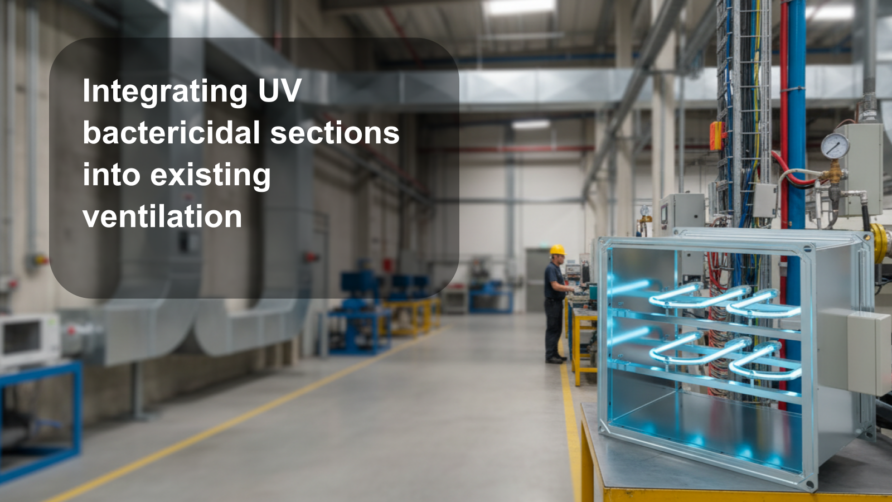
Integration must minimize structural changes while maintaining airtightness and safety. The section is installed directly in the duct where air receives UV exposure, preserving aerodynamic characteristics.
Installation quality checks include measuring airflow before and after the section, pressure drop, connection tightness, and absence of vibrations. Excessive resistance can overload fans, reducing system reliability.
Common installation faults—such as flange gaps or incorrect lamp orientation—cause air leaks, insufficient UV dose, and potential UV leakage into occupied spaces, posing safety hazards. These errors accelerate equipment failure.
Best practices for installation:
- Use flanged connections with seals.
- Align lamps parallel to airflow for uniform irradiation.
- Provide maintenance access.
- Prevent UV radiation from reaching work areas.
Selecting and calculating bactericidal section power for specific applications
Required power and lamp count depend on air volume, flow velocity, and target disinfection level. Power is calculated based on the UV dose needed to reduce microbial load to normative thresholds.
Engineers verify section compatibility with ventilation parameters using airflow data and measure actual UV intensity with specialized instruments, comparing results to project requirements.
Underpowered sections compromise disinfection, increasing microbial risks. Overpowered units raise energy consumption and shorten lamp life.
It is advisable to design with a power margin accounting for operational conditions and lamp fouling. High-power amalgam UV lamps offer stable output and longevity. Optimal lamp configuration maximizes efficiency while minimizing energy use.
Case study: installation errors in food production ventilation
Initial conditions
A sauce packaging facility installed three UV bactericidal sections to disinfect air feeding open containers, retaining the existing ventilation layout.
Issues observed
- Increased microbial contamination near packaging.
- Reduced ventilation performance.
- Elevated noise and vibrations.
- Rapid lamp failures.
- Air leaks at section joints.
Root causes
Improper installation without flange sealing caused air leaks and UV dose reduction. Lamps were angled incorrectly, missing part of the airflow. Air velocity parameters were ignored, causing excessive resistance and equipment wear.
Inspection checklist
- Seal integrity and gasket presence.
- Lamp orientation relative to airflow.
- Air velocity before and after sections.
- UV dose uniformity inside sections.
- Condition of lamps and electronic ballasts.
- Absence of vibration and noise.
- Compliance with design parameters.
- Maintenance access availability.
Corrective actions
- Reinstall sections with proper sealing.
- Align lamps parallel to airflow.
- Adjust fan speed for optimal flow.
- Replace damaged lamps and ballasts.
- Install vibration isolation.
- Re-verify UV dose and airflow.
Implementation steps
- Develop installation plan respecting existing ventilation.
- Use certified sealing and fastening materials.
- Train personnel in UV equipment maintenance.
- Establish maintenance schedules.
- Monitor section performance regularly.
- Coordinate lamp replacement with production cycles.
Outcome monitoring
Post-correction microbial levels met standards, ventilation operated smoothly without excess noise, and lamp lifespan extended. Ongoing maintenance preserved disinfection efficiency and prevented failures.
Common pitfalls in bactericidal section integration
- Inadequate airflow assessment leading to incorrect power selection.
- Installation errors: missing seals, wrong lamp positioning.
- Neglecting routine maintenance causing lamp fouling and UV output drop.
- Insufficient safety measures against direct UV exposure.
- Equipment mismatched to non-standard duct sizes without proper adaptation.
- Incorrect electronic ballast choice causing unstable lamp operation and reduced lifespan.
Pre-installation checklist for bactericidal sections
- Verify airflow parameters: velocity and volume.
- Ensure airtight duct connections.
- Confirm maintenance access.
- Match section power to required UV dose.
- Check material compatibility and duct dimensions.
- Incorporate UV radiation shielding.
- Account for vibration and noise control.
- Review technical documentation and certifications.
- Train staff on operation and servicing.
- Plan regular monitoring of operational parameters.
- Maintain spare lamps and parts inventory.
- Develop lamp replacement and preventive maintenance protocols.
Frequently asked questions before purchase and integration
Which airflow parameters affect section selection?
Primarily velocity and volume, influencing UV dose delivery and section sizing. Miscalculations reduce disinfection effectiveness.
Can bactericidal sections be installed without duct modifications?
Depends on duct geometry; often requires section body adaptation or transition fittings.
How often should UV lamps be replaced?
Amalgam lamps typically last about 16,000 operating hours; replacement is recommended per schedule or upon output decline.
What safety measures are mandatory during operation?
Prevent direct personnel exposure via protective housings and warning signage.
How is disinfection effectiveness verified on-site?
Using UV sensors and microbiological air sampling before and after the section.
What to do if air leaks are detected at installation joints?
Immediately seal leaks with appropriate gaskets and regularly inspect connections.
Is it advisable to use one section for multiple zones with varying loads?
Separate sections per zone are preferred to ensure consistent disinfection and avoid energy wastage.
Integrating UV bactericidal sections into existing ventilation systems demands a precise engineering approach and strict adherence to technical standards. Success hinges on accurate power calculation, quality installation respecting airflow parameters, and systematic maintenance with performance monitoring. Initial system analysis, measurement, and pilot commissioning are essential to identify and correct discrepancies before large-scale deployment.