Who needs this information and when
- Wastewater treatment system designers—to select appropriate UV equipment and water pretreatment technologies.
- Industrial process engineers—to optimize disinfection efficiency and reduce operational costs.
- Water treatment specialists—to monitor water quality before UV units.
- UV equipment operators—to promptly detect and resolve performance issues.
- Environmental compliance officers—to ensure treated effluent meets discharge standards.
- Clients and contractors—to assess economic feasibility and reliability of solutions.
- Engineering system integrators—to coordinate filtration and UV disinfection within the treatment cycle.
How turbidity and suspended solids affect UV disinfection efficiency
UV disinfection relies on ultraviolet light penetrating the water flow to inactivate microorganisms by damaging their DNA. Turbidity and suspended solids scatter and absorb UV radiation, reducing the dose reaching pathogens. Higher turbidity decreases effective UV penetration depth, leading to incomplete disinfection and potential microbial survival.
In modern industrial practice, turbidity in wastewater after primary treatment can range from 5 to over 50 NTU. For stable UV system performance, turbidity should generally be maintained below 10 NTU. On-site turbidity measurement using a turbidimeter is sufficient to assess compliance. If turbidity exceeds acceptable levels, additional coarse filtration is required.
Ignoring turbidity results in reduced UV system efficiency—operators must either increase lamp power or reduce flow rates to achieve the required UV dose, leading to higher energy consumption and accelerated equipment wear. Ultimately, this risks non-compliance with sanitary regulations.
A recommended approach is staged filtration, starting with mechanical filters such as mesh and sand filters, combined with continuous turbidity monitoring at the UV system inlet. Although modern multi-lamp UV sterilizers may have UV intensity sensors that adjust lamp output, these controls cannot fully compensate for high turbidity without prior filtration.
Influence of chemical water composition on UV disinfection
Beyond mechanical impurities, chemical constituents in wastewater significantly impact UV disinfection. Substances like organic compounds, iron, manganese, and petroleum hydrocarbons absorb UV radiation, reducing its bactericidal effectiveness. Additionally, chlorinated organics or ammonia can affect photochemical reactions within the UV reactor.
Regular laboratory analysis is essential to monitor parameters affecting UV performance: organic load (COD, BOD), iron, hydrocarbons, etc. On-site rapid tests, such as oxidation-reduction potential (ORP) and water colorimetry, can supplement laboratory data.
Neglecting chemical analysis leads to decreased UV efficiency, requiring higher UV doses and increasing electricity consumption and lamp replacement frequency. Some chemical contaminants also accelerate degradation of quartz lamp sleeves, shortening equipment lifespan.
Practically, incorporating chemical stabilization steps—such as aeration, coagulation, or clarification—before the UV unit helps reduce UV-absorbing substances, improving disinfection quality and extending equipment service life.
Filtration as a mandatory step in water pretreatment for UV disinfection
Filtration before UV disinfection is an indispensable stage that removes suspended solids and lowers turbidity, ensuring even UV transmittance through the water flow. Filter selection depends on raw water quality and system capacity.
Effectiveness is verified by measuring turbidity before and after filtration and monitoring filter inlet and outlet pressure to detect clogging and schedule backwashing. Strict maintenance protocols are critical to sustain reliable operation.
Insufficient filtration causes UV light attenuation by particles, diminishing bactericidal efficiency and increasing microbial contamination risks. This may lead to discharge quality violations and secondary contamination.
A multi-stage filtration scheme with automatic backwash and parameter control is advised. For large systems, sand filters, mesh filters with 50–100 micron openings, and membrane technologies can be integrated. Filtration should be linked with UV system controls for real-time diagnostics.
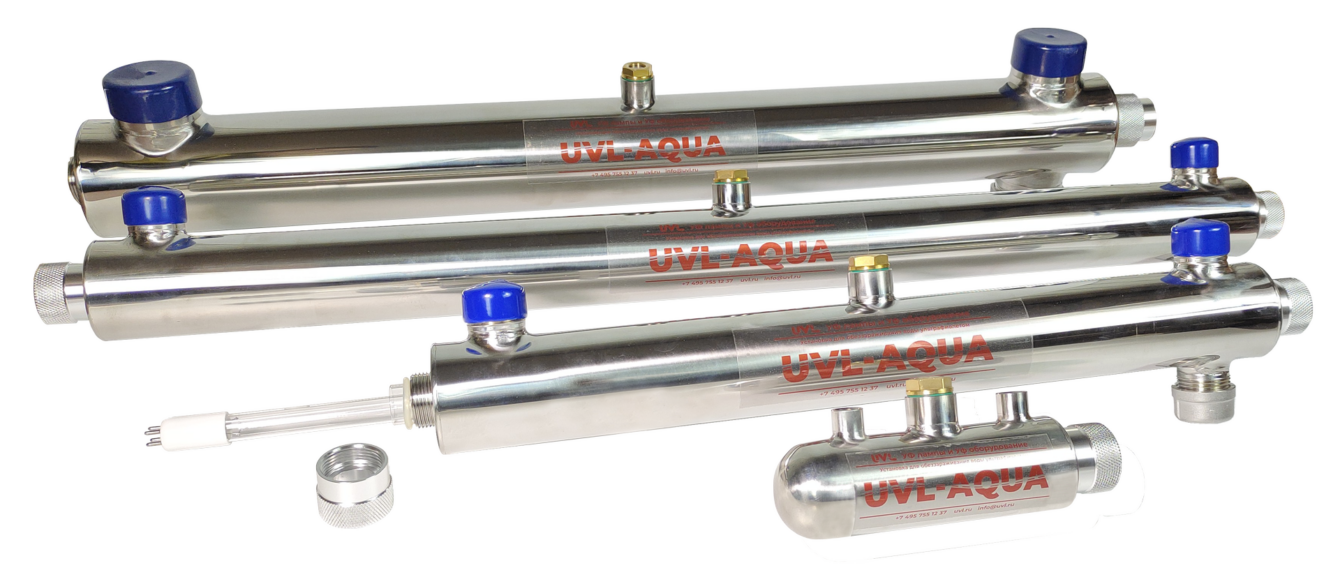
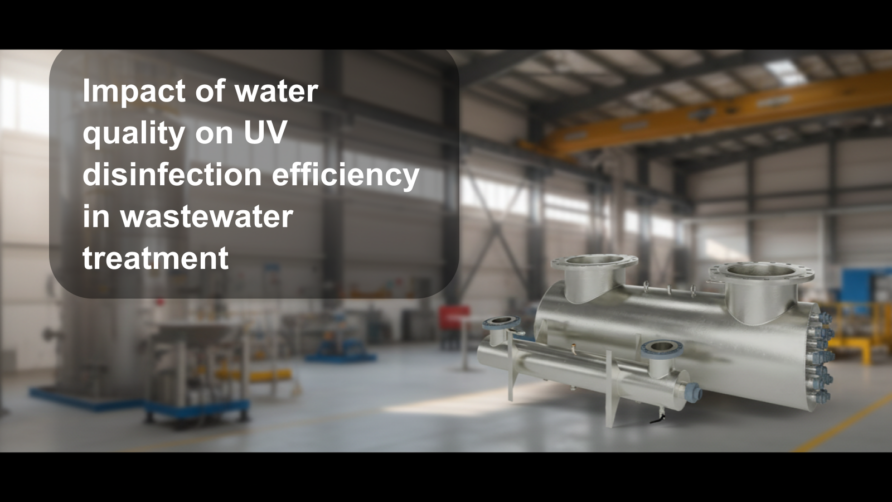
Stainless steel housing units provide water disinfection up to 99% SA in the water treatment system. They are connected to the pipeline using pipes of various cross-sections. Upon request, it is possible to produce a unit with the required parameters.
Case study: Reduced UV disinfection efficiency due to inadequate wastewater pretreatment
Initial conditions:
An industrial facility installed a multi-lamp UV sterilizer rated for 600 L/s. Water came post grit and oil separators but lacked comprehensive filtration before the UV unit.
Symptoms:
- Frequent alarms for UV intensity drop.
- Microbiological results of treated water failing standards.
- Rapid degradation of quartz sleeves.
- Increased energy consumption maintaining UV dose.
- Lamp and reactor chamber fouling.
Root cause:
Elevated turbidity (>15 NTU) and presence of oil residues not removed during pretreatment reduced UV transmittance. Suspended solids settled on lamps, impairing performance and lifespan. UV sensors registered intensity drops, causing lamps to operate near limits.
Checks to perform:
- Turbidity at UV inlet.
- Levels of petroleum hydrocarbons and organics.
- Filter pressure and condition.
- Quartz sleeve and lamp status.
- UV sensor functionality.
- Flow and hydraulic parameters.
- Microbiological data at inlet and outlet.
- Compliance of pretreatment with design specifications.
Remedial actions:
- Implement multi-stage filtration: mesh and sand filters.
- Install oil removal systems.
- Regularly monitor turbidity and chemical composition.
- Calibrate and maintain UV sensors.
- Adjust lamp operation based on water quality.
- Schedule routine quartz sleeve maintenance and replacement.
Implementation:
- Integrate filtration into existing layout.
- Train staff on monitoring and maintenance.
- Configure automation for lamp power adjustment.
- Establish continuous water quality monitoring.
- Update maintenance schedules.
- Conduct follow-up microbiological testing.
Outcome:
Post-implementation, microbiological indicators stabilized, energy consumption decreased, and lamp lifespan extended. The UV system operated reliably, confirmed by ongoing monitoring.
Common errors in water pretreatment for UV disinfection
Frequent mistakes include underestimating turbidity impact and neglecting regular monitoring. Some engineers omit filtration or select undersized filters. Ignoring chemical contaminants such as organics and oils also compromises UV efficiency.
Insufficient maintenance—clogged filters, dirty sleeves, faulty sensors—reduces performance. Incorrect lamp sizing without considering actual water quality leads to excess energy use or inadequate disinfection.
Avoid:
- Skipping systematic turbidity and chemical monitoring.
- Neglecting multi-stage filtration.
- Delaying filter and lamp cleaning/replacement.
- Disregarding automatic UV dose control.
- Poor equipment selection relative to water parameters.
Checklist before implementing UV wastewater disinfection
- Measure raw water turbidity.
- Assess petroleum hydrocarbons and organic content.
- Design multi-stage filtration.
- Determine UV dose with safety margin.
- Choose UV system with automatic parameter control.
- Ensure capacity for regular water quality monitoring.
- Provide easy access for lamp and filter maintenance.
- Include sediment removal and filter backwash systems.
- Train personnel on equipment operation and monitoring.
- Develop maintenance protocols.
- Schedule microbiological testing pre- and post-installation.
- Verify equipment compliance with industry standards.
Frequently asked questions before UV system purchase and commissioning
What turbidity level is acceptable for UV disinfection?
Ideally, turbidity should be below 10 NTU. Higher turbidity requires additional filtration to maintain UV effectiveness.
Is filtration optional before a UV sterilizer?
In industrial settings, filtration is essential. Suspended solids and organics impair UV penetration and increase equipment wear.
How is the required UV dose determined?
Dose calculation is based on microbial load and water characteristics, typically ranging from 25 to 30 mJ/cm² for wastewater.
How to monitor disinfection effectiveness on-site?
Regular turbidity measurements, UV intensity monitoring, and microbiological testing before and after treatment.
What if UV intensity decreases?
Inspect and clean or replace quartz sleeves; check filters and incoming water quality.
Which filters are recommended for pretreatment?
Mesh filters with 50–100 micron openings and sand filters are common for coarse removal.
How often should UV equipment be serviced?
Monthly inspection and cleaning of sleeves; lamp replacement per manufacturer’s schedule, usually every 1–2 years.
In conclusion, wastewater quality is a critical factor governing UV disinfection performance. Proper pretreatment and filtration prevent unnecessary UV dose increases and extend equipment service life, optimizing resource use and ensuring regulatory compliance. The next step is on-site data collection and pilot testing to refine system parameters and establish operational protocols for reliable long-term operation.