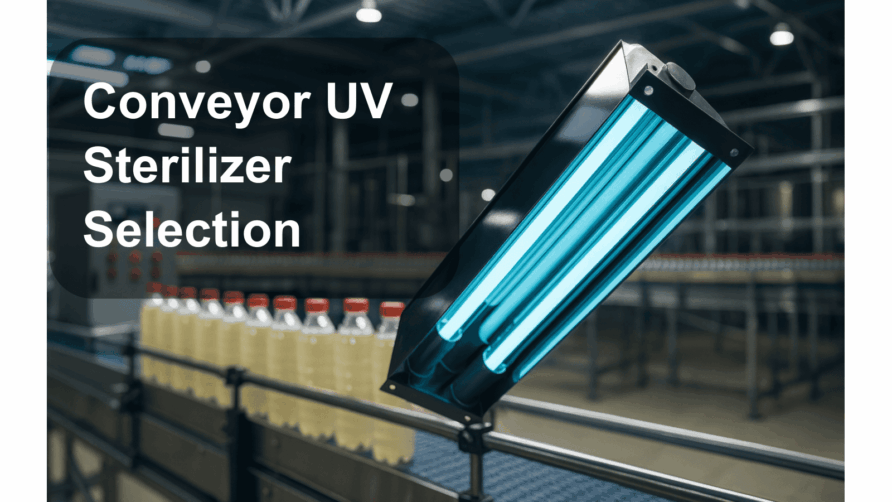
Reducing microbial load on packaging and food products is a critical challenge in modern food production. Conveyor UV irradiators enable automated surface disinfection directly on moving lines, eliminating manual contact and minimizing cross-contamination risks. For engineers and process technologists, selecting the right equipment is essential to ensure consistent line performance and compliance with hygiene standards without unnecessary resource consumption. Mistakes in power rating, lamp arrangement, or exposure time settings often lead to insufficient disinfection or damage to products and packaging.
This article examines how to technically evaluate irradiator parameters, verify on-site performance, and avoid common pitfalls. For example, at a beverage bottling facility, improper lamp installation caused uneven disinfection of bottle caps, detected only after multiple audits. In another case, insufficient lamp power resulted in increased microbial contamination on packaging and subsequent quality complaints.
Who Needs This and When
- Food manufacturers aiming to reduce microbial contamination on packaging to enhance hygienic safety and extend shelf life.
- Automation engineers responsible for integrating UV irradiators into conveyor lines without causing downtime.
- Process technologists overseeing sanitary control to maintain consistent disinfection throughout packaging stages.
- Quality assurance specialists verifying compliance with hygiene standards and documenting disinfection effectiveness.
- Production line designers planning equipment selection and placement based on process requirements.
- Warehouse and logistics managers needing to disinfect finished products on packaging lines.
- Service engineers organizing scheduled maintenance and timely lamp replacement.
Technical Principles of Conveyor UV Irradiators and Their Impact on Performance
Ultraviolet radiation at approximately 254 nm wavelength targets microbial DNA and RNA, disrupting their structure and thereby disinfecting surfaces. In conveyor applications, the key parameter is the UV dose, determined by lamp power, exposure time, and distance to the surface. Because products move continuously on the belt, exposure time is limited by conveyor speed, while uniform irradiation depends on lamp design and positioning.
Incorrect power selection or lamp layout can cause under-disinfection or localized “cold spots” in the UV coverage area. On-site performance verification employs specialized UV sensors and microbial test indicators at control points. It is critical to measure both the intensity of UV radiation at product contact points and the uniformity of coverage across the conveyor width.
Mounting the irradiator too high reduces intensity and dose, while positioning lamps too close risks packaging damage or altering product properties. Neglecting these factors leads to reduced disinfection efficacy, increasing microbial contamination risk and product quality claims. It also results in excessive energy consumption and frequent lamp replacements due to overheating or improper use, raising operational costs and downtime.
It is recommended to choose irradiators with adjustable power output and height settings. Protective shields made from UV-blocking materials must be installed to ensure operator and equipment safety. Integrated sensors and periodic surface measurements help maintain process control.
Criteria for Selecting Lamp Power and Wavelength for Conveyor Irradiators
Lamp power is a fundamental parameter directly affecting disinfection rate and penetration depth. For food applications, amalgam lamps emitting at 254 nm are commonly used due to their effectiveness against pathogenic microorganisms. Individual lamp power typically ranges from 25 to 80 W, with the total number of lamps selected based on conveyor width and required UV dose.
When selecting power, conveyor speed must be considered: faster belt speeds require higher irradiation intensity to compensate for shorter exposure times. Packaging material and geometry also influence dosing needs—smooth surfaces require lower doses than porous or textured ones, where shadows and crevices reduce UV effectiveness.
On-site validation uses UV radiometers to record actual intensity at multiple points on product surfaces. If possible, testing different power and speed modes helps identify the optimal balance.
Power miscalculations result in either insufficient microbial reduction or product damage due to excessive UV exposure. Overexposure also accelerates lamp wear and increases energy usage.
Amalgam lamps are preferred for their power stability and long service life. Models allowing staged power increases enable flexibility to adapt to evolving process requirements.
Lamp Design and Arrangement: Effects on Uniformity and Disinfection Efficiency
A conveyor UV irradiator comprises a housing with lamps, reflectors, and protective shields. Lamp configuration significantly impacts UV distribution both along and across the conveyor.
Common arrangements include single-row, staggered, or triangular patterns. Triangular layouts provide more uniform coverage and reduce low-intensity zones, especially on wide belts, but require more complex mounting and increase equipment size.
Reflectors made of polished stainless steel or aluminum enhance efficiency by redirecting scattered UV radiation back onto products. The quality and proper installation of reflectors are critical factors influencing total irradiator output.
Uniformity is verified using UV sensors placed along the conveyor width. Detected low-intensity areas necessitate lamp repositioning or additional sources.
Ignoring these design aspects can lead to under-disinfected zones, raising local microbial loads and product spoilage risk. Attempts to compensate with higher power increase energy consumption unnecessarily.
Flexible lamp arrangements that adapt to conveyor width and product shape are recommended. Reflectors should be corrosion-resistant and easy to maintain.
Case Study: Uneven Disinfection of PET Bottle Caps on a Conveyor Line
Initial conditions: A soft drink production line with automated filling and capping. Cap disinfection was performed using a single row of 40 W amalgam lamps mounted 30 cm above the conveyor.
Issues observed:
- Elevated microbial contamination on parts of the caps.
- Sanitary non-compliance detected during internal audits.
- Increased packaging quality complaints.
- Frequent equipment shutdowns due to lamp overheating.
Root causes:
The single-row lamp layout failed to provide uniform coverage, particularly at conveyor edges. The installation height was too high, causing insufficient UV intensity. Lack of reflectors reduced overall irradiation efficiency. Lamp overheating led to unstable operation and premature failure.
Inspection checklist:
- UV intensity distribution across the conveyor width.
- Lamp mounting height and tilt angle.
- Presence and condition of reflectors.
- Lamp operating temperature.
- Conveyor speed.
- Product feed uniformity and absence of overlapping.
Implemented solutions:
- Reconfigured lamps into a triangular layout for uniform irradiation.
- Lowered the irradiator by 15–20 cm to increase intensity.
- Installed stainless steel reflectors.
- Added temperature monitoring and automatic shutdown on overheating.
- Adjusted conveyor speed to match irradiator capacity.
Implementation steps:
- Removed old irradiator and installed redesigned unit.
- Calibrated and adjusted intensity sensors.
- Conducted test measurements and fine-tuned lamp height and angle.
- Trained staff on maintenance and monitoring protocols.
- Activated monitoring and emergency shutdown systems.
Outcome: The system consistently delivered the required UV dose across the entire zone, confirmed by lab tests. Microbial contamination dropped to acceptable levels, and related complaints and downtime ceased.
Common Mistakes in Selecting and Implementing Conveyor UV Irradiators
- Underestimating conveyor speed, resulting in insufficient UV dose.
- Incorrect irradiator height reducing effective power.
- Ignoring the role of reflectors, lowering system efficiency.
- Poor lamp arrangement causing uneven UV coverage critical for food products.
- Lack of temperature control and lamp condition monitoring leading to premature equipment failure.
- Delayed lamp replacement and dirty protective shields degrading performance.
- Absence of built-in monitoring and diagnostics reducing system reliability.
Pre-Implementation Checklist for Conveyor UV Irradiators
- Verify lamp power matches conveyor speed and product type requirements.
- Ensure adjustable height and tilt angle settings are available.
- Assess UV intensity uniformity across the conveyor width.
- Confirm presence and quality of reflectors.
- Check lamp operating temperature control.
- Provide adequate UV shielding for personnel safety.
- Integrate monitoring and equipment condition control systems.
- Schedule regular maintenance and lamp replacement.
- Confirm compatibility with existing automation systems.
- Evaluate scalability and upgrade potential.
- Ensure availability of documentation and operating procedures.
- Perform on-site pilot testing before full production launch.
Frequently Asked Questions Before Purchase and Installation
How to determine the required irradiator power?
Calculate based on conveyor speed, irradiated surface area, and product type. Determine the UV dose needed for effective disinfection and select lamps accordingly.
Is a single row of lamps sufficient for wide conveyors?
Single rows may suffice for narrow lines. For wider belts, triangular or staggered layouts provide more uniform coverage.
What housing materials are recommended?
Stainless steel is preferred for food production due to corrosion resistance, ease of cleaning, and inertness.
How to monitor disinfection effectiveness?
Use UV radiometers to measure irradiation intensity and periodically conduct microbiological tests on products.
What if lamps overheat?
Ensure proper cooling and implement automatic shutdown mechanisms. Overheating reduces lamp life and disinfection efficiency.
Can irradiators be upgraded if processes change?
Modern units allow adding lamps or modifying layouts without full replacement, facilitating adaptation to new requirements.
How often should lamps be replaced?
Amalgam lamps typically last several thousand hours. Follow manufacturer guidelines and monitor intensity levels.
In summary, selecting conveyor UV irradiators for food product disinfection requires a comprehensive approach considering lamp power, conveyor speed, lamp arrangement, and operating conditions. The key criterion is achieving the required UV dose with uniform coverage while avoiding product damage. The next steps involve collecting accurate production data and conducting pilot testing to ensure technical and process compliance. Subsequently, system design and implementation should incorporate maintenance and monitoring protocols for reliable operation.