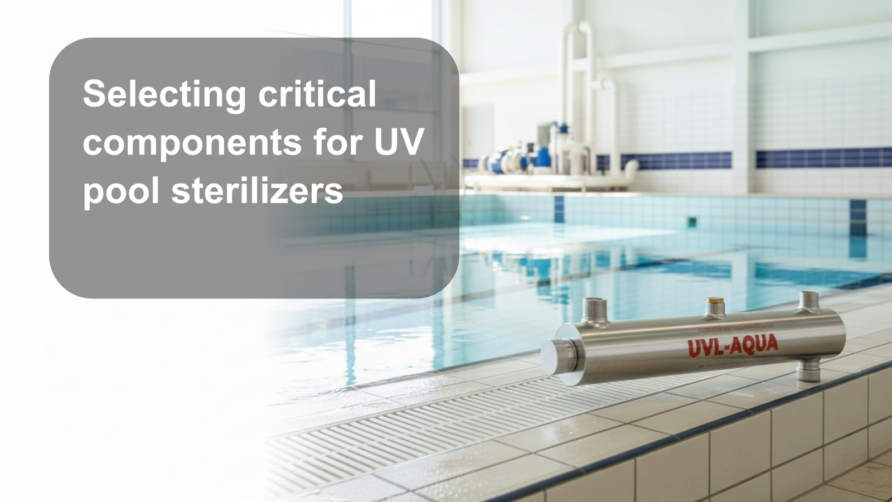
Disinfecting pool water with ultraviolet radiation is an engineering task that requires precise selection of components. The quality of electronic ballasts (EBs), quartz sleeves, and connectors directly affects the UV system’s disinfection efficiency, operational stability, and equipment lifespan. Incorrect choices or installation can reduce UV dose, cause frequent downtime, and increase maintenance costs.
For engineers and technologists, understanding why these components impact results and how to avoid common mistakes is essential. This article reviews how to select EBs considering power and startup characteristics, what to check when choosing quartz sleeves, and how to properly connect system elements to ensure sealing and reliability. Real-world cases illustrate failures caused by incompatibility and mechanical damage.
You will gain clear selection criteria, on-site verification recommendations, and operational advice to minimize downtime and maintain the UV sterilizer’s effectiveness in pool water treatment.
Target audience and timing
- Engineers designing water disinfection systems—to select compatible components and ensure reliable operation.
- Pool technologists—to understand component influence on UV disinfection quality.
- Service engineers—during diagnostics and repairs of UV units.
- Procurement specialists—to assess technical parameters and cost-effectiveness.
- Project managers overseeing system modernization—to prevent downtime from component incompatibility.
- Installation teams—for correct connection and system sealing.
- Operational personnel—for timely maintenance and monitoring.
Electronic ballasts (EBs): why selection is critical
EBs control UV lamp operation by providing stable power, correct current, and voltage needed to maintain optimal UV output. They initiate lamp ignition, regulate operation modes, and protect against overheating and overvoltage.
The choice of EB directly impacts lamp lifespan and water disinfection quality. An incompatible ballast can cause unstable startups, frequent restarts, and reduced UV output. Important factors include lamp power, EB type (electromagnetic or electronic), socket compatibility, and operating modes (e.g., ozone-free).
On-site verification involves confirming stable lamp ignition, absence of faults, and checking current values. Visual inspection should detect overheating or burning smells. Measuring UV dose at the sterilizer outlet verifies performance.
Using an unsuitable EB risks premature lamp failure and diminished disinfection capacity, leading to higher replacement costs and potential regulatory non-compliance.
It is recommended to select EBs certified for specific lamp models, with automatic monitoring and protection features, and to perform regular power and startup parameter checks. Installation must follow manufacturer instructions and ensure effective cooling.
Quartz sleeves: protection and UV transmission role
The quartz sleeve is a transparent protective barrier isolating the lamp from water while transmitting UV radiation into the treatment zone. Sleeve material quality affects UV transmittance and resistance to mechanical and chemical stresses.
Technically, the quartz sleeve must have precise dimensions to fit tightly and seal the lamp within the sterilizer housing. Poor-quality or damaged sleeves reduce UV dose due to clouding or cracks, potentially causing leaks, corrosion, and equipment failure.
On-site checks start with visual inspection for cracks, scratches, or deposits. UV transmission can be measured using spectrophotometers or specialized sensors. Proper installation requires correct alignment and tight fit.
Neglecting sleeve condition lowers sterilizer efficiency, resulting in insufficient water disinfection and frequent repairs. Replacement should follow maintenance schedules using original-quality sleeves.
High-quality quartz sleeves with guaranteed transparency and chemical resistance to pool agents are recommended. During installation, avoid mechanical damage and maintain cleanliness.
Connectors and sealing: ensuring reliable connections
Connectors in pool UV sterilizers provide electrical connections between lamps, EBs, and system components. They also ensure sealing to prevent water ingress into electrical parts and protect against corrosion.
Connectors must deliver stable electrical contact without current loss or sparking. Their design and materials need to withstand humidity, temperature fluctuations, and chemical exposure in pool environments.
On-site inspection includes visual checks for corrosion, secure attachment, and tight connections. Contact resistance measurements and spark tests during startup are essential. Special attention is given to seals and insulation.
Compromised sealing can cause short circuits, EB and lamp failures, and safety hazards. Low-quality connectors reduce system reliability and increase maintenance expenses.
For stable operation, use connectors rated IP67 or higher, with durable seals and materials compatible with aggressive pool conditions. Installation must follow safety protocols with thorough connection verification.
Case study: error analysis in lamp replacement for a marine park UV sterilizer
Initial conditions:
A marine park installed a UV disinfection system with medium-pressure lamps and EBs. During scheduled lamp replacement, similar power lamps with slightly different dimensions were used. This caused startup errors and reduced effectiveness.
Symptoms:
- Startup failures and spontaneous sterilizer shutdowns.
- Decreased UV dose output.
- Quartz sleeve damage during new lamp installation.
- Frequent EB restarts with overheating.
- Loss of housing sealing.
Cause:
Mismatch in lamp length and diameter induced mechanical stress on housing and quartz sleeves, causing microcracks and poor UV transmission. Connectors failed to ensure tight contact, causing current interruptions. The EB operated in fault mode due to unstable ignition and overloads.
Checks to perform:
- Exact lamp dimensions and compliance with technical specifications.
- Quartz sleeve integrity.
- Quality and sealing of electrical connections.
- EB operating parameters (current, voltage, temperature).
- UV radiation level at sterilizer outlet.
- Absence of mechanical housing damage.
- Component compatibility by technical data.
- Availability of certificates and documentation.
Solution:
- Ordered lamps closely matching original size and specs.
- Replaced quartz sleeves with standard-compliant originals.
- Upgraded connectors to higher sealing models.
- Adjusted EB settings for new lamps and performed commissioning.
- Implemented regular system parameter monitoring.
Implementation:
- Conducted phased installation with stepwise testing.
- Trained staff on new component operation and maintenance.
- Established maintenance and replacement schedules.
- Set up UV dose and equipment condition monitoring.
- Maintained supplier communication for prompt support.
Outcome:
Post-implementation, the system consistently delivered required UV dose, startup errors ceased, and lamp lifespan increased. Reduced downtime and improved water microbiological quality were reported.
Common mistakes in component selection and operation
A frequent error is choosing EBs without considering lamp specs, causing overheating and failure. Cost-cutting on quartz sleeves by using non-original or damaged parts reduces disinfection efficiency. Incorrect connector installation and poor sealing lead to short circuits and shutdowns.
Lack of routine parameter monitoring and delayed replacement of worn components degrade UV disinfection quality and increase repair costs. Improper storage of lamps and sleeves shortens service life.
Comprehensive compatibility checks, adherence to technical requirements, and maintenance protocols are essential for long-term stable operation of pool UV sterilizers.
Pre-implementation checklist for pool UV sterilizers
- Verify EB and lamp compatibility by power and type.
- Ensure availability of spare quartz sleeves with quality guarantees.
- Check connector sealing and protection rating.
- Confirm lamp dimensions match technical documentation.
- Arrange UV dose measurement post-installation.
- Configure and test EB startup system.
- Implement temperature and current monitoring.
- Train maintenance personnel.
- Develop maintenance and replacement schedules.
- Perform test runs and commissioning on-site.
- Prepare complete documentation package.
- Organize regular system monitoring and reporting.
Frequently asked questions before purchase and implementation
How to select an EB for a specific lamp?
Base selection on lamp power, operating voltage, socket type, and working modes. Refer to manufacturer data and recommendations.
Why is the quartz sleeve important for effectiveness?
It protects the lamp from water and mechanical damage and affects UV transmission. Poor sleeves reduce UV dose and lamp lifespan.
How to check connector sealing?
Visually inspect for corrosion and damage, measure contact resistance, and verify absence of sparking during operation.
What to do if UV dose decreases?
Check lamp and quartz sleeve condition, EB power parameters, and connection sealing. Replace worn components as needed.
How often should quartz sleeves be replaced?
Inspect seasonally and replace if damaged or discolored.
Can alternative lamps be used?
Only those fully matching original dimensions and specifications to avoid malfunctions.
How to ensure safety during installation?
Follow manufacturer instructions, protect against moisture and corrosion, use personal protective equipment, and verify electrical connections.
In summary, selecting components for pool UV sterilizers is a complex, technically responsible task. The key criterion is full compatibility and ensuring stable system operation. The next steps include collecting equipment data, conducting pilot installations, and developing operational protocols for reliable water disinfection.