Who needs UV air disinfection and when
- Ventilation engineers integrating UV units into air exchange systems.
- Food production technologists aiming to reduce microbial load in processing areas.
- Sanitation and hygiene specialists organizing preventive air disinfection.
- Engineering system designers selecting appropriate UV equipment types and capacities.
- Service engineers responsible for maintenance and performance monitoring of UV units.
- Production managers planning budgets and ensuring compliance with hygiene standards.
- Occupational safety professionals ensuring safe operation of UV installations.
Features of UV air disinfection in food production
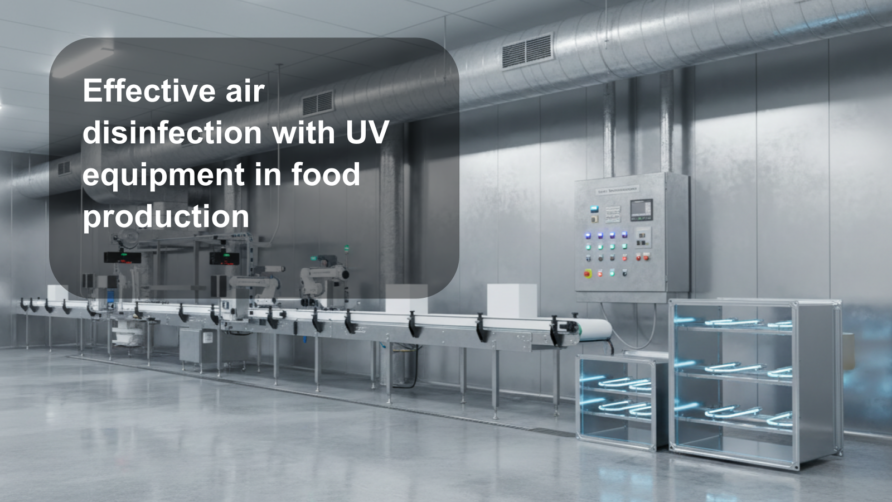
Ultraviolet radiation at approximately 254 nm effectively disinfects air by disrupting microbial DNA and RNA. In food production, two main UV air disinfection types are used: open UV lamps and enclosed UV air recirculators. Open UV lamps are typically employed when personnel are absent, such as during shift changes or post-cleaning. They provide rapid (up to 30 minutes) and thorough air disinfection but require strict access control to prevent UV exposure to workers.
In contrast, UV air recirculators operate safely in occupied spaces. They draw ambient air into a chamber containing UV lamps, disinfect it, and return the cleaned air to the room. This continuous process maintains consistent air quality without interrupting production. Effectiveness depends on accurate airflow calculations and the number of recirculators installed.
Performance verification on site involves measuring UV irradiance at the lamp chamber outlet and monitoring airflow velocity. It is essential to confirm that the device meets its specifications and that air distribution within the room is uniform. For open UV lamps, it is critical to check for any UV leakage into occupied zones and ensure warning signals are in place.
Incorrect selection or installation, such as insufficient UV power or poor placement, results in inadequate air disinfection, increased microbial contamination, and risks to product quality. Improper use of open UV lamps can also pose health hazards to personnel.
Recommendations include precise power calculation based on room volume, adherence to exposure time standards, and equipment positioning considering air circulation patterns. Open UV systems must have interlocks and visual warnings; recirculators require routine technical inspections and timely lamp replacement.
Technical requirements for UV air disinfection installation and operation
Proper placement of UV air disinfection units is critical for disinfection efficiency and operational safety. UV intensity decreases sharply with distance, so open UV lamps are typically ceiling- or wall-mounted to ensure even coverage of the target air volume, taking airflow direction and shadow zones into account.
UV air recirculators should be positioned in relation to existing ventilation—natural or mechanical—to maximize the volume of air passing through the UV chamber. Pressure differentials must be avoided as they can reduce airflow and disinfection efficiency. Verification must confirm no stagnant air zones exist and that the entire room air volume cycles through the UV chamber within the prescribed time.
Installing UV units in corners or low airflow areas leads to uneven disinfection and microbial hotspots. For open lamps, improper placement can cause UV exposure in occupied areas, violating safety protocols.
It is advisable to use airflow models and UV intensity measurements to select optimal mounting locations. During operation, regularly inspect protective screens and verify interlock system functionality.
Case study: errors in implementing an open UV lamp in a packaging area
Initial conditions: An open UV air disinfection lamp was installed to disinfect a 120 m² packaging room (360 m³ volume) overnight. The system operated without monitoring UV intensity.
Symptoms observed:
- Elevated airborne microbial contamination confirmed by lab tests.
- Sanitation officer reported periodic noncompliance with hygiene standards.
- Lack of visual warnings about UV lamp operation.
- Operating time less than 15 minutes instead of required 30 minutes.
- Personnel entered the room during UV lamp operation multiple times.
Root causes:
Insufficient planning and lack of UV intensity measurements led to actual lamp power below specification. Shortened exposure time failed to achieve required disinfection. Absence of interlocks and warning signs created safety risks, discouraging proper system use.
Checklist for verification:
- Measure UV irradiance at the working site.
- Confirm operation time matches protocol.
- Ensure presence of interlocks and visual alarms.
- Verify correct device placement per design.
- Train personnel on safety procedures.
- Review microbiological air monitoring results.
- Check lamp condition and electronic components.
- Schedule regular maintenance.
Corrective actions:
- Adjust operation modes based on irradiance measurements.
- Install automatic timers to enforce exposure duration.
- Add warning signs and indicator lights.
- Relocate lamp to area with uniform air circulation.
- Conduct safety training for staff.
- Implement routine microbiological monitoring.
Implementation plan:
- Develop operational and control protocols.
- Organize personnel training and access control.
- Integrate automatic shutdown on room entry.
- Install UV intensity sensors.
- Perform scheduled technical inspections.
- Maintain detailed logs of maintenance and monitoring.
Effectiveness is verified through periodic microbial load assessments and continuous technical parameter monitoring, enabling timely adjustments to maintain disinfection standards.
Common mistakes in selecting and operating UV air disinfection units
A frequent error is choosing equipment power without considering room size and configuration, resulting in insufficient disinfection. Ignoring the rule of no personnel presence during open UV lamp operation creates health hazards.
Incorrect placement, especially of recirculators, can cause air stagnation zones with high microbial loads. Neglecting lamp condition monitoring and replacement reduces bactericidal performance.
Often, insufficient staff training and absence of warning signs lead to safety violations. Lack of automatic shutdown systems and timers exacerbates these issues.
Pre-installation checklist for UV air disinfection systems
- Assess room volume and layout to calculate required power.
- Select UV unit type based on operational mode and personnel presence.
- Verify technical specifications and certifications.
- Evaluate placement options considering airflow patterns.
- Ensure interlock and warning systems are installed.
- Organize personnel training on operational safety.
- Plan regular microbiological air monitoring.
- Schedule maintenance and lamp replacement intervals.
- Confirm compatibility with existing engineering systems.
- Implement UV irradiance monitoring systems.
- Align project with sanitary and technical standards.
- Develop operational and monitoring protocols.
Frequently asked questions before purchase and implementation
How to choose between open UV lamps and recirculators?
Open lamps suit disinfection during personnel absence for limited periods; recirculators operate continuously in occupied spaces.
Which parameters impact disinfection effectiveness?
Key factors include UV lamp power, exposure time, air volume, airflow velocity, and uniformity of circulation.
How to ensure personnel safety with open UV lamps?
Install interlocks, warning signs, and enable remote control of lamp operation.
How often should UV lamps be replaced?
Typically after 8,000–10,000 operating hours to maintain bactericidal efficiency.
Can UV units be integrated into ventilation systems?
Yes, duct-mounted UV systems disinfect air within supply and exhaust ventilation.
What regulations govern UV air disinfection equipment?
Requirements are defined in current sanitary guidelines and technical standards for UV air treatment.
How to monitor UV unit performance?
Through regular UV irradiance measurements and microbiological air analyses.
What actions to take if microbial contamination rises?
Check equipment condition, operating modes, and air circulation; then adjust accordingly.
Can UV units be used in high-humidity environments?
Yes, provided the equipment has appropriate protection and humidity effects are considered.
In summary, selecting and implementing UV air disinfection in food production requires a comprehensive approach—from technical sizing to safe operation and ongoing monitoring. The primary goal is achieving the required disinfection level without compromising workplace conditions. Initial steps include gathering data on room volume and microbial load, conducting pilot tests, and preparing project documentation aligned with regulatory standards. This enables reliable and effective air disinfection tailored to your production needs.