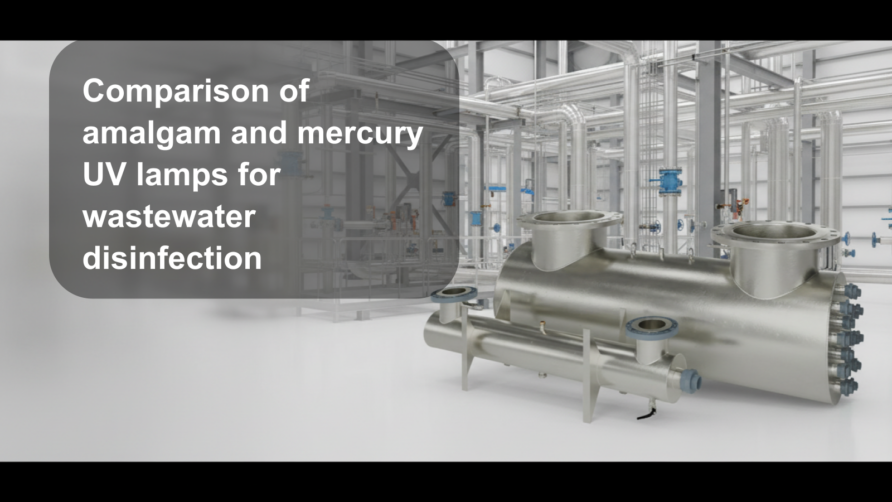
Ultraviolet (UV) disinfection of wastewater has become a critical stage in treatment processes across numerous industrial and municipal facilities. The choice of UV lamp type directly impacts disinfection efficiency, operating costs, and system reliability. For engineering and process teams, understanding why amalgam or mercury lamps are used, how they perform under wastewater conditions, and the risks associated with improper selection is essential. This article clarifies technical details, evaluates advantages and drawbacks of each lamp type, and highlights common pitfalls during design and operation.
For example, in scenarios with unstable water levels inside sterilizers, amalgam lamps demonstrate greater resistance to overheating compared to mercury lamps. Conversely, in facilities with poor power quality, mercury lamps may experience significant drops in bactericidal output due to voltage fluctuations. We will explain how to assess lamp performance onsite and actions to take when parameters fall below required standards.
Who needs this information and when
- Design engineers — to select appropriate lamps during UV system design.
- Treatment plant technologists — to optimize operation modes and extend equipment lifespan.
- Service engineers — for diagnostics and lamp replacement considering operational conditions.
- Production managers — to evaluate economic efficiency of UV disinfection implementation.
- Environmental specialists — to ensure compliance with wastewater disinfection regulations.
- Equipment suppliers — to advise clients and tailor solutions to specific tasks.
- Automation system designers — for integrating UV intensity monitoring and lamp control.
Physics and technology of amalgam and mercury UV lamps
UV lamps used for wastewater disinfection emit bactericidal radiation near 254 nm wavelength, which damages microbial DNA and reduces microbial load. Mercury lamps contain mercury vapor, whose pressure and temperature determine UV intensity and stability. Amalgam lamps are a type of mercury lamp where mercury is alloyed in an amalgam form, providing more stable vapor pressure and thermal conditions.
A key operational factor is lamp temperature. Mercury lamps require maintaining an optimal temperature around 40°C to achieve peak bactericidal output. Deviations reduce UV intensity and disinfection effectiveness. Amalgam lamps are less sensitive to temperature fluctuations and voltage variations, making them more robust under challenging industrial conditions.
Lamp performance onsite can be monitored using specialized UV sensors that continuously measure intensity and alert to power drops. Temperature of the lamp envelope and supply voltage should also be tracked, as deviations affect disinfection performance.
Neglecting temperature and voltage control causes mercury lamps to lose effectiveness rapidly, risking insufficient wastewater disinfection and non-compliance. Amalgam lamps maintain stable output under such conditions but involve higher initial investment.
Recommendation: use amalgam lamps where power supply and temperature are unstable; mercury lamps suit well-controlled environments. Incorporating automatic lamp power adjustment and UV intensity monitoring enhances system reliability.
Energy consumption and service life: factors affecting operational cost
UV disinfection operating costs depend on lamp power, stability, and replacement frequency. Amalgam lamps generally consume less energy at stable output and last up to 16,000 hours, whereas standard mercury lamps typically last 9,000–12,000 hours. Longer lifespan of amalgam lamps reduces maintenance and replacement expenses.
Energy consumption can be verified onsite via power meters and compared with lamp specifications. Measuring bactericidal output with specialized instruments helps assess lamp efficiency over time. Lamps should be replaced if output drops by more than 30%.
Choosing mercury lamps over amalgam to reduce upfront costs may lead to frequent downtime and higher maintenance expenses. Mercury lamps also require stricter temperature and voltage control, increasing operational complexity.
To reduce costs, combine amalgam lamps with automatic UV intensity control and power management systems. This approach extends lamp life and ensures consistent wastewater disinfection.
Impact of wastewater quality on lamp selection
Wastewater contains suspended solids, organic matter, and chemicals that can deposit on quartz sleeves, reducing UV transmission. Mercury lamps are more sensitive to sleeve fouling and require regular cleaning. Amalgam lamps tolerate such conditions better due to stable operation under temperature fluctuations and variable intensity modes.
Regular inspection of quartz sleeves and water transparency is crucial to maintain disinfection efficiency. Cleaning sleeves at least monthly and monitoring water turbidity, color, and organic content is recommended.
Ignoring sleeve fouling decreases disinfection effectiveness, increasing microbial load and risking regulatory non-compliance. Mercury lamps suffer more pronounced performance loss due to their sensitivity to reduced UV flux.
Amalgam lamps are preferable for wastewater with high turbidity and organic contamination. Both lamp types benefit from automatic UV intensity monitoring and timely sleeve cleaning.
Case study: lamp selection error in a treatment plant with unstable voltage
Initial conditions
A wastewater UV disinfection system was installed using mercury lamps at an industrial site with voltage fluctuations ±15% from nominal and a flow rate of 85 m³/h.
Symptoms
- UV bactericidal output dropped to 35% of nominal.
- Elevated microbial load in treated water.
- Frequent lamp overheating shutdowns.
- Increased lamp replacement and repair costs.
- Process instability complaints from technologists.
Cause analysis
Mercury lamps are highly sensitive to voltage variations. A drop below 90% nominal voltage reduces bactericidal output by 15% or more. Frequent fluctuations cause unstable operation, overheating, and accelerated lamp failure. Lack of automatic UV intensity monitoring prevented timely response to performance decline. The system failed to deliver required disinfection levels.
What to check
- Voltage fluctuation amplitude.
- Operating temperature of lamp envelopes.
- Presence of UV intensity monitoring system.
- Condition and transparency of quartz sleeves.
- Maintenance frequency and quality.
- Water parameters (turbidity, organic content).
- Lamp power compliance with design specs.
- Alarm signals and equipment logs.
Solution
- Replace mercury lamps with more stable amalgam lamps.
- Install voltage stabilizers or uninterruptible power supplies.
- Implement automatic UV intensity control and lamp power regulation.
- Organize regular maintenance and quartz sleeve cleaning.
- Train personnel on operational parameter monitoring.
- Deploy water quality monitoring.
Implementation
- Coordinate lamp replacement project with technologists and electricians.
- Remove old and install new equipment.
- Calibrate UV sensors.
- Monitor voltage and temperature continuously.
- Conduct commissioning and performance tests.
- Establish maintenance protocols.
Results
Post-implementation, bactericidal output stabilized above 90% nominal. Microbiological water quality met standards, and maintenance costs decreased by 25%. Continuous monitoring enabled prompt detection of deviations and ensured reliable system operation.
Common mistakes in lamp selection and operation
A frequent error is neglecting voltage and temperature effects on mercury lamp performance, leading to reduced UV output and premature lamp replacement. Underestimating the need for regular quartz sleeve cleaning also lowers disinfection efficiency. Choosing lamp types without considering wastewater quality and operating conditions causes operational failures and added costs. Absence of automatic UV intensity monitoring reduces responsiveness to performance drops. Poor power supply design and lack of voltage stabilizers exacerbate mercury lamp issues.
Pre-implementation checklist
- Verify power supply quality and presence of stabilizers.
- Plan for automatic UV intensity monitoring.
- Assess wastewater parameters (turbidity, organics).
- Select lamp type based on operating conditions.
- Schedule regular maintenance and sleeve cleaning.
- Monitor lamp envelope temperature.
- Confirm lamp power matches design requirements.
- Train staff on equipment operation.
- Keep spare lamps and parts in stock.
- Install alarm and fault signaling systems.
- Coordinate project with technologists and electricians.
- Implement post-startup disinfection quality control.
Frequently asked questions before purchase and installation
Which lamp type is better for industrial wastewater?
Amalgam lamps are preferred for unstable conditions and high turbidity; mercury lamps suit stable environments with controlled power.
How to verify UV disinfection effectiveness onsite?
Use UV sensors to monitor intensity, track lamp temperature and water parameters, and perform periodic microbiological testing.
What to do if bactericidal output decreases?
Check quartz sleeve condition, power supply quality, lamp temperature, and replace lamps if output drops over 30%.
How often should lamps be replaced?
Amalgam lamps last up to 16,000 hours, mercury lamps about 10,000 hours; replacements should be planned and triggered by output decline.
Is UV disinfection without monitoring systems feasible?
Automatic control is strongly recommended to maintain UV dose and optimize energy use.
How does water quality influence lamp choice?
High turbidity and organic load require amalgam lamps and frequent sleeve cleaning to maintain efficiency.
What are common operational errors?
Ignoring voltage fluctuations, neglecting sleeve cleaning, late lamp replacement, and lack of monitoring.
Can lamp cost savings cause problems?
Saving on lamp type stability leads to higher maintenance costs and non-compliance risk.
How to integrate UV disinfection into existing treatment?
Consider water parameters, ensure power compatibility, and implement UV intensity monitoring systems.
Conclusion
Choosing between amalgam and mercury UV lamps for wastewater disinfection should be based on operating conditions, water quality, and power stability. The key criteria are stable bactericidal output and lamp lifespan. Starting with thorough onsite data collection, conducting pilot tests, and implementing comprehensive monitoring ensures cost-effective, reliable UV disinfection that meets regulatory requirements.