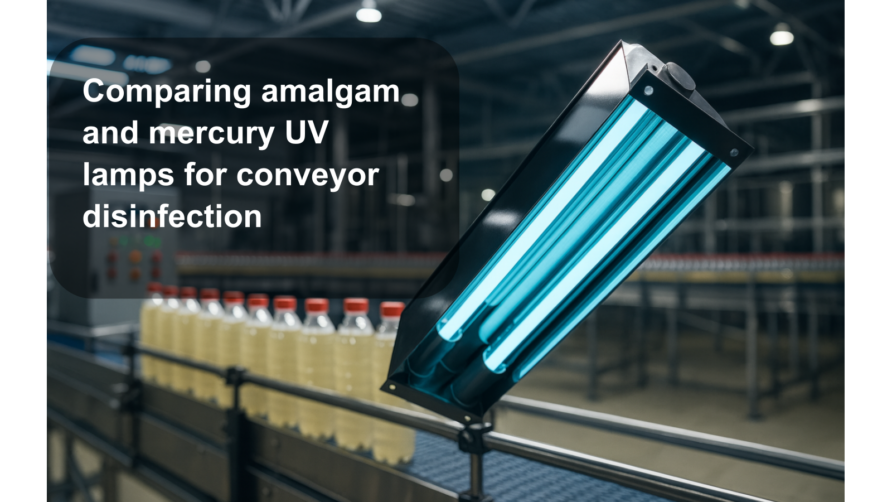
In modern industrial processes requiring product disinfection on conveyor lines, selecting the appropriate type of germicidal UV lamp is crucial. Engineers and technologists must understand how amalgam and mercury lamps affect disinfection efficiency, equipment lifespan, and operational specifics. Incorrect lamp choice or improper installation can result in insufficient disinfection, premature lamp failure, or increased maintenance costs.
This article reviews the key technological and operational differences between amalgam and mercury germicidal lamps, their impact on UV dose delivery, and maintenance considerations. Engineering recommendations are provided to support informed decisions and avoid common mistakes. For example, in one dairy plant project, an improper lamp choice led to frequent overheating and reduced lamp life; in another case, unstable UV doses were caused by voltage fluctuations.
Who Needs to Consider These Differences and When?
- Automation and conveyor maintenance engineers — to select equipment that ensures stable UV dose under specified technical conditions.
- Food and pharmaceutical technologists — to guarantee consistent disinfection without compromising throughput.
- Disinfection system designers — to accurately calculate lamp and power supply parameters within spatial constraints.
- Maintenance teams — to plan replacement schedules and monitor lamp condition effectively.
- Facility managers with stringent hygiene requirements — to minimize microbial contamination risks and pass audits.
- Power supply specialists — to account for voltage variations impacting lamp performance and durability.
- UV equipment suppliers and integrators — to properly select components and tailor systems to specific tasks.
Understanding the lamp construction and operation principles is essential to grasp how these factors influence conveyor disinfection performance.
How Do Amalgam and Mercury UV Lamps Operate and Affect Disinfection?
Both amalgam and mercury germicidal lamps are low-pressure UV lamps emitting primarily at 254 nm, effectively disinfecting surfaces and air. Their main difference lies in composition and design: amalgam lamps contain a mercury alloy (amalgam) that stabilizes internal vapor pressure, providing more uniform UV output despite temperature and voltage fluctuations.
In contrast, mercury lamps contain pure mercury and are sensitive to temperature changes and start-up modes. At low temperatures, mercury vapor pressure drops, reducing UV intensity. Amalgam lamps maintain stable output over a wider range of conditions, which is critical in conveyor irradiators with limited space and variable temperatures.
Practically, amalgam conveyor irradiators deliver a more precise UV dose, ensuring uniform product disinfection. However, amalgam lamps require longer warm-up times to reach operational output, affecting equipment start cycles.
What Should Be Checked On Site
To verify lamp type and condition on site, check:
- Lamp markings and technical documentation.
- UV intensity using specialized luxmeters or UV radiometers.
- Voltage stability at ballast devices.
- Ambient temperature at lamp installation.
- Warm-up duration before reaching nominal power.
Neglecting these factors risks reduced disinfection due to insufficient UV dose, accelerated lamp wear, compromised product quality, and non-compliance with hygiene standards. For instance, mercury lamps used in low-temperature environments without heating can experience up to a 30% drop in germicidal flux.
Engineering Recommendation
Designers should consider temperature regimes and power supply stability, favoring amalgam lamps in variable conditions or confined spaces. Electronic ballasts with monitoring functions for lamp runtime and UV intensity are recommended for lamp condition control.
Operational Characteristics and Lifespan of Amalgam and Mercury Lamps
Amalgam germicidal UV lamps typically offer up to 12,000 hours of service life, with germicidal output decreasing by no more than 20–30% by end of life. The amalgam stabilizes mercury vapor pressure, reducing overheating risks and failure during frequent switching.
Mercury lamps generally have shorter lifespans of 8,000–10,000 hours and are more sensitive to voltage and temperature fluctuations. This sensitivity can diminish germicidal flux and increase replacement frequency, which is critical in conveyors with repeated on/off cycles and vibration.
How to Check Lamp Condition
Lamp condition checks include:
- Reading operating hours from electronic ballasts.
- Visual inspection for darkening or damage.
- Measuring germicidal flux with UV radiometers.
- Monitoring power supply stability.
- Checking installation temperature.
Ignoring these parameters can cause premature lamp failure, conveyor downtime, and extra replacement costs. Declining UV intensity without timely lamp replacement leads to insufficient disinfection.
How to Improve Operational Stability
Use electronic ballasts with remote monitoring and automatic shutdown below critical parameters. Scheduled maintenance and lamp replacement based on operating hours maintain consistent disinfection levels.
Installation and Operational Conditions Influencing Lamp Choice for Conveyor Irradiators
Conveyor lines often have limited space for irradiator installation, imposing size and configuration constraints. Amalgam lamps are generally more compact and heat-resistant, enabling installation in tight zones with intense thermal conditions.
Mercury lamps require careful cooling and temperature control; otherwise, their efficiency decreases. For high conveyor speeds, uniform UV dose distribution is essential, more easily achieved with amalgam lamps due to their consistent emission.
What to Check During Installation
Installation checks should include:
- Measuring ambient temperature near lamps.
- Assessing airflow and cooling.
- Verifying uniform UV distribution across the conveyor width.
- Ensuring absence of shadows and contamination on lamps and reflectors.
- Analyzing conveyor speed to match exposure time.
Ignoring these factors can cause under-dosed zones, lamp overheating, and reduced equipment lifespan. For example, mercury lamps installed in sealed enclosures without adequate cooling suffer reduced germicidal output and frequent replacements.
Recommended Installation Approach
Design systems considering lamp features and mounting conditions, use reflectors and cooling systems, and provide for remote operational parameter monitoring.
Case Study: Unstable Disinfection in a Dairy Facility Due to Incorrect Lamp Selection
Initial Conditions
A conveyor irradiator was installed for packaging disinfection in a dairy plant. The technological area experienced water level fluctuations in open pools by 10–15 cm, with ambient temperatures ranging from +15 to +25 °C. A mercury-based conveyor irradiator was selected without accounting for these conditions.
Symptoms
- Frequent lamp failures due to overheating.
- Unstable UV dose reducing disinfection effectiveness.
- 15% increase in line downtime.
- Higher costs for lamp replacement and repairs.
- Technologists reported product quality issues.
Cause Analysis
Mercury lamps were partially exposed above fluctuating water levels, causing overheating and mercury vapor pressure drops inside the lamp. This led to sharp decreases in germicidal flux and shortened lamp life. Lack of remote monitoring prevented early detection of UV intensity decline.
What to Check
- Lamp type and markings.
- Temperature regime and lamp position relative to water level.
- Cooling and ventilation availability.
- Power supply voltage and ballast stability.
- UV dose measurements along the conveyor.
- Reflector condition and lamp cleanliness.
- Monitoring system presence for runtime and intensity.
- Lamp warm-up time to nominal output.
Solution
- Replace mercury lamps with amalgam ones featuring stable mercury vapor pressure.
- Install remote monitoring with indicators and counters.
- Adjust irradiator mounting considering water level fluctuations.
- Ensure effective cooling and ventilation of the irradiator housing.
- Implement scheduled lamp replacement based on runtime.
- Train personnel in equipment parameter monitoring.
Implementation Steps
- Remove old mercury lamps and install amalgam lamps.
- Configure and integrate electronic ballasts with monitoring systems.
- Modify mounts to accommodate water level changes.
- Verify temperature and ventilation post-installation.
- Launch pilot section with control measurements.
- Establish maintenance and monitoring protocols.
Results
Post-implementation, UV dose stabilized, downtime decreased, and lamp lifespan reached the expected 12,000 hours. Technologists reported improved disinfection quality, confirmed by internal audits.
Common Mistakes in Selecting and Operating Conveyor UV Irradiators
Frequent errors include ignoring temperature and voltage conditions critical for mercury lamps. Improper installation neglecting cooling and radiation distribution causes uneven disinfection. Failure to monitor lamp runtime and replace lamps timely reduces disinfection efficiency. Absence of remote monitoring delays problem detection. Incorrect lamp type selection without considering process specifics—such as using mercury lamps for frequent on/off cycles—is common. Additionally, irregular maintenance and reflector/lamp cleaning degrade germicidal flux and increase contamination risk.
Therefore, proper selection and operation require comprehensive analysis of production conditions and equipment technical parameters.
Pre-Implementation Checklist for Conveyor UV Irradiators
- Verify lamp type and specifications relative to operating conditions.
- Provide temperature control and ventilation at installation site.
- Check power supply stability and parameters.
- Ensure presence of remote lamp operation monitoring.
- Determine required UV dose based on product and conveyor speed.
- Allow easy access for lamp maintenance and replacement.
- Confirm irradiator dimensions fit spatial constraints.
- Assess integration capability with enterprise IT systems.
- Organize scheduled maintenance and parameter control.
- Conduct pilot tests with intensity measurements.
- Train staff in equipment monitoring and servicing.
- Document test results for audits and future analysis.
These steps minimize risks and ensure stable disinfection system performance.
Frequently Asked Questions Before Purchase and Implementation
How Do Amalgam Lamps Differ From Mercury Lamps in Lifespan?
Amalgam lamps generally last longer—up to 12,000 hours—due to stable internal pressure and reduced sensitivity to temperature fluctuations.
How Do Voltage Fluctuations Affect UV Irradiator Effectiveness?
Voltage drops over 10% reduce germicidal flux by about 15%, lowering disinfection dose and risking non-compliance with process requirements.
Can Mercury Lamps Be Used in High Humidity and Variable Temperature Environments?
Yes, but only with additional temperature control and cooling; otherwise, lamp lifespan and output efficiency decline.
How to Verify That the UV Dose on the Conveyor Meets Standards?
Measure UV intensity at multiple points using a UV radiometer and compare to design values.
Is Remote Monitoring Necessary and Why?
Yes, it enables timely detection of lamp power reduction, runtime tracking, and prevents equipment downtime.
How Often Should Lamps Be Replaced in Conveyor Irradiators?
Replace after reaching rated operating hours, typically 8,000–12,000 hours, or when UV intensity falls below acceptable levels.
What Installation Considerations Apply in Limited Space?
Ensure effective cooling, uniform radiation distribution, and convenient access for maintenance without disrupting production.
Can Irradiators Integrate With Enterprise IT Systems?
Modern electronic ballasts support data transmission on lamp status and performance for centralized monitoring and analytics.
Summary
Choosing between amalgam and mercury germicidal UV lamps for conveyor irradiators depends on operating conditions, dose stability requirements, and lifespan expectations. Amalgam lamps are better suited for environments with variable temperature and voltage, providing more stable disinfection and longer service life. The key criterion remains matching lamp technical parameters to the specific process and enabling equipment condition monitoring. Next steps include gathering production data, conducting pilot tests, and developing operational protocols to ensure efficient and reliable UV disinfection systems.