Ultraviolet disinfection of industrial wastewater has become a standard practice to ensure environmental safety and regulatory compliance. Accurate calculation of the power for multi-lamp UV sterilizers is a critical design step that directly impacts disinfection effectiveness and operational efficiency. Engineers and technologists must understand how water characteristics and operational conditions influence equipment selection to avoid under-disinfection or excessive energy consumption. This article outlines how to determine the necessary UV system power, key onsite verification methods, and the consequences of incorrect calculations. Typical scenarios include insufficient UV dose at high flow rates and overestimating power under variable water quality.
Who needs this and when
- Water treatment system designers — for selecting appropriate UV sterilizer power and configuration.
- Operations engineers — to monitor and adjust equipment performance under real conditions.
- Production technologists — to assess disinfection impact on overall process flow.
- Environmental specialists — for confirming compliance with microbiological safety standards.
- Engineering system integrators — to coordinate UV units with other treatment stages.
- Project managers — to plan budgets and timelines based on technical requirements.
- Automation specialists — for setting up UV lamp power monitoring and control.
Key factors influencing UV sterilizer power calculation
UV disinfection operates by damaging microorganisms’ DNA through ultraviolet radiation. Effectiveness depends on the UV dose, which is a function of lamp power and water exposure time in the treatment zone. In multi-lamp systems, total lamp power must deliver the calculated dose considering flow parameters and water quality.
Water transparency is crucial—turbidity and organic matter reduce UV penetration, necessitating increased power or additional pretreatment. Flow rate also matters: higher flow shortens exposure time, requiring higher radiation intensity. Incorrect power calculation results in either incomplete disinfection or wasted energy and premature lamp failure.
Onsite verification involves measuring UV dose with specialized sensors and monitoring water parameters such as turbidity, color, and flow rate. UV intensity should be checked at the outlet of the sterilizer and compared against target values. If the dose is insufficient, power must be increased or flow rate reduced.
Undersized power leads to inadequate microbial reduction, risking regulatory violations. Oversized power increases operational costs and shortens lamp lifespan, negatively affecting project economics.
It is recommended to include a 10–15% power margin during design, account for raw water quality, and enable power adjustment to accommodate seasonal variations. Automatic UV sensors are advisable for real-time lamp power control.
Accounting for wastewater characteristics when selecting power
Physicochemical properties of wastewater determine how much UV radiation reaches microorganisms. Key parameters include turbidity, color, suspended solids, and organic content. Higher turbidity increases UV absorption and scattering, reducing effective dose.
Power calculation requires measuring the UV transmittance coefficient of the water, typically expressed as a percentage, which affects radiation penetration depth. Low transmittance necessitates either increased lamp power or preliminary water clarification (filtration, coagulation).
Water quality is monitored onsite using turbidimeters and chemical analysis, with attention to parameter stability. Daily or seasonal fluctuations impact UV disinfection efficiency; ignoring this leads to variable performance of the same equipment.
Failure to consider water quality results in either insufficient UV dose and incomplete disinfection or excessive power consumption and shortened lamp life, both harming operational and economic performance.
Regular water quality monitoring and adjusting sterilizer operation—such as reducing flow or increasing lamp power when transparency worsens—are recommended. Integrating UV and turbidity sensors into control systems facilitates automated adjustments.
Power calculation considering flow rate and water retention time
Wastewater flow rate directly affects retention time inside the UV sterilization chamber and thus the delivered UV dose. As flow increases, exposure time decreases, requiring higher lamp power or more lamps to maintain disinfection efficiency.
This is because microorganisms require a certain UV dose (mJ/cm²) to disrupt DNA. Reduced contact time must be compensated by increased radiation intensity. In multi-lamp setups, powers sum up, but uniform radiation distribution across the water flow is essential.
Flow meters measure actual flow onsite, and retention time is monitored. Deviations from design parameters necessitate power adjustments or flow regulation. Uniformity of UV intensity distribution is checked to avoid underexposed zones.
Ignoring flow or retention time can cause some water to receive insufficient UV dose, lowering overall disinfection effectiveness. Conversely, excessive power at low flow wastes energy.
Optimal power calculation must jointly consider flow, water quality, and disinfection targets. Provision for adjustable power and flow rate, supported by sensors for automated process control, is advisable.
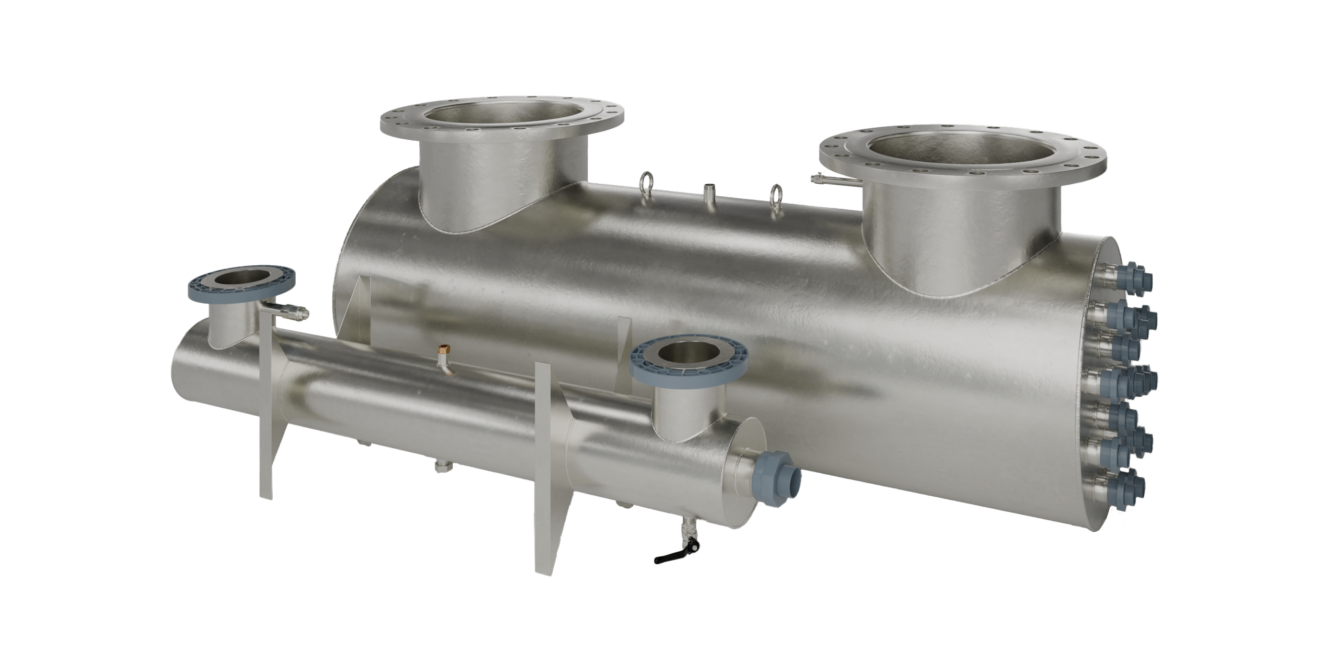
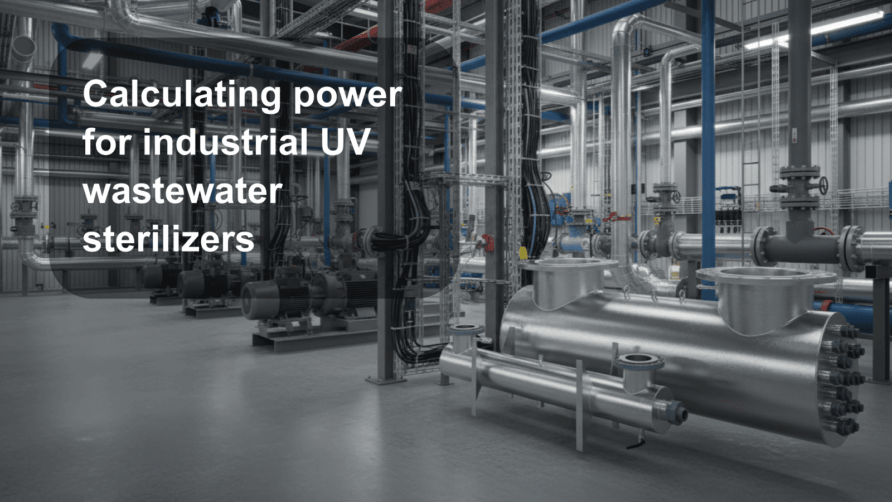
Multi-lamp UV pressure units in a stainless steel housing are used for water treatment. They can be made of AISI 316 or AISI 304 steel, with any performance parameters suitable for your system.
Case study: insufficient UV sterilizer power in food concentrate production
Initial conditions:
A multi-lamp UV sterilizer was installed post-biological treatment with power sized for a design flow of 300 L/s. Water turbidity was 15 NTU, with peak flows reaching 350 L/s.
Symptoms:
- Frequent microbiological standard violations at outlet
- Elevated energy consumption without expected disinfection results
- Lamp overheating and frequent replacements
- Environmental concerns over discharge quality
- Uneven UV intensity distribution within the chamber
Causes:
Underestimation of peak flow and water quality variability. Higher turbidity reduced UV transmittance, and flow spikes shortened exposure time, jointly lowering delivered dose below requirements. Lack of automatic UV intensity control prevented timely lamp power adjustments. Improper lamp arrangement caused zones of insufficient UV exposure.
Verification checklist:
- Actual maximum wastewater flow and fluctuations
- Water turbidity and UV transmittance coefficient
- UV intensity distribution across sterilization chamber
- Presence and calibration status of UV sensors
- Water retention time at various flows
- Electrical parameters and lamp condition
- Availability of automatic lamp power control
- Compliance of installed power with design specifications
Solutions:
- Recalculate power based on maximum flow and water quality
- Increase lamp quantity and upgrade to higher-power models
- Optimize lamp placement for uniform radiation
- Implement automatic UV intensity monitoring and power adjustment
- Adjust operating modes according to current wastewater parameters
- Conduct retesting and sensor calibration
Implementation steps:
- Dismantle and upgrade existing equipment
- Install new lamps and configure control system
- Train operations and maintenance staff
- Establish regular monitoring of water parameters and UV dose
- Develop operational adjustment protocols
- Perform periodic inspections and technical audits
Result control:
Post-implementation monitoring confirmed consistent microbiological safety and UV disinfection parameters. Sensor integration and automated control maintained required UV dose despite wastewater variability, reducing compliance risks and optimizing energy use.
Common mistakes in multi-lamp UV sterilizer design and operation
Typical errors reducing effectiveness or increasing costs include:
- Insufficient water quality analysis and ignoring variability in turbidity and organics leading to inaccurate power calculation.
- Neglecting peak flow values, resulting in inadequate power reserve and incomplete disinfection.
- Absence or miscalibration of UV sensors, preventing real dose monitoring.
- Incorrect lamp placement causing “dead zones” with low UV intensity.
- Delayed lamp replacement and lack of scheduled maintenance, reducing UV output.
- No automatic power adjustment based on wastewater parameters.
- Noncompliance with operational guidelines for power and exposure time.
Addressing these issues is essential to achieve stable and effective UV disinfection of industrial wastewater, impacting treatment quality and operating costs.
Pre-implementation checklist for multi-lamp UV sterilizer
- Assess wastewater quality (turbidity, organics, chemical composition).
- Account for maximum and minimum flow rates with safety margin.
- Calculate required UV dose per regulatory or process standards.
- Verify lamp technical specifications and lifespan.
- Ensure uniform lamp arrangement within the chamber.
- Install UV and turbidity sensors for process control.
- Provide automatic lamp power regulation system.
- Develop schedules for maintenance and lamp replacement.
- Enable operational mode adjustments in real time.
- Conduct commissioning tests measuring UV dose and disinfection efficacy.
- Train operational and control personnel.
- Coordinate project with environmental and sanitary oversight.
Frequently asked questions before purchase and commissioning
How to determine the required power for my facility?
Calculate based on wastewater flow, quality (especially turbidity), and target disinfection level to define UV dose and select lamp number and power accordingly.
Can one UV unit handle variable flows?
Yes, if equipped with power or flow rate regulation to maintain required UV dose across different conditions.
How to verify that UV dose is sufficient?
Use UV sensors measuring radiation intensity at the sterilizer outlet to monitor actual dose.
What if water quality changes during the day?
Implement automatic monitoring and adjust lamp power or flow rate to sustain disinfection effectiveness.
How often should lamps be replaced?
Lamp life varies by model, typically 8,000 to 12,000 operating hours; scheduled maintenance and replacement are necessary to maintain output.
Why is UV disinfection preferable to chlorination?
UV disinfects without chemical additives, avoids harmful byproducts, and eliminates the need for dechlorination, reducing environmental impact.
Can UV sterilizers integrate into existing treatment systems?
Yes, with proper power calculation and coordination with other treatment stages.
What affects UV system lifespan?
Water quality, correct operation, timely maintenance, and effective control system functioning.
In conclusion, accurate power calculation for multi-lamp UV sterilizers is fundamental for effective industrial wastewater disinfection. Critical factors include comprehensive assessment of water parameters and flow dynamics, alongside implementation of automatic monitoring and control systems. The next steps involve detailed site data collection, pilot testing, and tailored project design to ensure reliable and cost-efficient operation.